Tuesday, July 11, 2006

choosing our words

Ginger and I moved to Boston in August of 1990 and settled in Charlestown, the neighborhood of Boston that is home to Bunker Hill and the USS Constitution. We had not been in town long when we started going to neighborhood meetings about the impact of The Big Dig, which was the nickname given to the tunnel they planned to build under Boston so I-93 could run under the city rather than through it. The reason we were having meetings was the highway would come back above ground in our neighborhood.

In 1991, even as meetings and protests continued, they broke ground on what has become the most expensive public works project in American history. When we were going to meetings, they said it would cost $2 billion; by the time they said the tunnel was finished in 2004 (even as construction crews have continued to work), it cost $15 billion. The builders were The Bechtel Corporation, who have friends in high places which has helped them land lucrative work rebuilding along the US Gulf Coast and in Iraq – all at far more than bargain prices.

The point of this strange little history lesson is this morning at 3:30 am, a car was traveling through one of the tunnels on the way to Logan Airport when a couple of Bechtel’s concrete ceiling panels, weighing a couple of tons each, broke loose from their steel ties and – to use one journalist’s verb – “pancaked” the car. A woman in the passenger seat was crushed and killed; the male driver was able to crawl out of a twelve-inch hole on his side because the panel fell at an angle. The tunnel and that section of the Mass Pike remained closed all day, as they will tomorrow, and traffic became more of a nightmare than normal. Our State Attorney General announced he wanted to file manslaughter charges and was treating the closed tunnel as a crime scene. All the local news outlets have been filled with stories of speculation, suspicion, and accusation. The politicians and government officials have tried to act as though they cared about the mismanagement of the project all along. Everyone is making lots of noise trying to explain, and no one is saying much of anything that matters.

And I keep thinking about the random tragedy of one car in the tunnel at three in the morning who, in one horrible moment was exactly where the giant piece of concrete fell. Five seconds later and she would have been the one on the news talking about a near miss. Instead, a thirty-eight year old woman is dead.

What do we do with that?

Years ago, my mother, whose sense of predestination would make John Calvin look indecisive, was booked on a Delta flight to somewhere and changed her plans at the last minute. The plane crashed.

“God really took care of me,” she said.

She found great comfort in her statement. I didn’t because, for me, it carried with it an inseparable corollary: God didn’t take care of the others. I don’t see how you can claim one half of the equation without the other. I also don’t think God works in that your-number’s-up kind of way. In the case of the woman in the tunnel, God was not the one dropping the concrete at just the right moment because it was “her time to go.”

Tomorrow Ginger is leading a funeral for a wonderful man from Marshfield named Bob who dropped dead this week at thirty-four. They are still trying to figure out what happened. Bob was co-owner of a skate and surf shop here in town and, from every account, was one of the most kind and loving human beings around. He had a huge heart, an adventuresome spirit, and an open door. He will be deeply missed. They are expecting over five hundred people to gather in the Skate Park for his service tomorrow. The autopsy report will come in the days that follow and answer some questions, but it will not help anymore than saying it was God’s will.

When it comes to tragedy, explanations don’t help one damn bit. The only words that can find us are those who speak to our souls. I “placed my grief in the mouth of language,” wrote poet Lisel Mueller, “the only thing that would grieve with me.” We explain to assuage our fear, or to focus blame; there is another language for sorrow and hope.

Try to Praise the Mutilated World
(Adam Zagajewski)

Try to praise the mutilated world
Remember June’s long days,
and wild strawberries, drops of wine, the dew,
The nettles that methodically overgrow
the abandoned homesteads of exiles.
You must praise the mutilated world.
You watched the stylish yachts and ships;
one of them had a long trip ahead of it,
while salty oblivion awaited others.
You’ve seen the refugees heading nowhere,
you’ve heard the executioners sing joyfully.
You should praise the mutilated world.
Remember the moments when we were together
in a white room and the curtain fluttered.
Return in through to the concert where music flared.
You gathered acorns in the park in autumn
and leaves eddied over the earth’s scars.
Praise the mutilated world
and the gray feather a thrush lost,
and the gentle light that strays and vanishes
and returns.
Jesus' words about tragedy were about God knowing when a sparrow fell. He did not say God pushed the sparrow on cue, nor did he say God caught the little bird before it hit the ground. He said God was present in the midst of even one of the smallest tragedy imaginable.

"I sing because I'm happy; I sing because I'm free," goes the chorus to one of my favorite songs. "His eye is on the sparrow and I know he watches me."

Let us praise our mutilated world.

Peace,
Milton

Monday, July 10, 2006

slow leak

I’ve been fishing for metaphors again.

I’ve had to fish like it’s my job because my depression has decided to see what summer is like in New England. The first step, for me, in dealing with it is naming it, which means finding a way to describe what is happening, which sends me fishing.

Sometimes it blows in like a storm front. I can see the gathering gloom on the horizon, smell the rain in the air, feel the change in barometric pressure. The lightning flashes and the thunder rolls, both giving me fair warning that the flood is coming and I can do little to stop it. The best I can do is put on my life jacket and ride it out.

Then there are times when it feels like a trap door. Without much warning at all, the floor opens up and I free fall into the abyss, grabbing for anything I can find to hold on to so I can stop my fall. I have also thought of it like the ending of a silent movie, where the frame closes down to a pinhole in the center of the screen and then goes completely dark; my task is to run toward the shrinking light so it never completely disappears.

Sometimes it’s claustrophobic: the walls closing in and the air seeping out, leaving me feeling suffocated and overwhelmed. It’s also like a dead weight on my chest both crushing me and squeezing the life out of me at the same time.

This week it has been like a tire with a slow leak. The lack of air pressure is not so noticeable at high speeds, but once I stop I find I’ve got a flat. I fill it up with air and keep going, but it keeps running out. I came home from Mission Trip exhausted, helped with Vacation Bible School at Marshfield (I’m the music guy), went back to work at the Red Lion, and began dealing with my resignation at Hanover being public. Life for me, has been at high speed. I have pumped up when I needed to and then collapsed; there has not been time to fix the flat, only moments to hook up the air hose, which means the leak grows and the air escapes more and more quickly.

Realizing I was more than tired has helped. Learning again that depression has some creative power, in that it finds new ways to invade is both empowering and disconcerting. It morphs like one of those viruses that learns how to beat the crap out of the latest antibiotic, sending the researchers back to find new medicine. With each new face, my depression calls me to live with profound creativity and determination, to not just rage against the dying of the light but to call it by name and force it to make room for all of who I am, so I can be more than depressed. Depression is part of me, both emotionally and chemically, but it is not all of me, regardless of how much of me it wants to claim.

Anytime I sit down to write about it, the other metaphor that comes to mind is that of a broken record: an annoyingly endless repeating loop that forces the listener to leave the room. I have to keep naming it to stay alive; I’m trusting there are at least some who are willing to hear more than the same thing over and over.

Peace,
Milton

Sunday, July 09, 2006

open space

Since the Round of Sixteen began, I have not gotten to see one World Cup game until today. I got to watch the Final this afternoon. For all of the other games, I was either in Mississippi or in the kitchen at the restaurant. I made sure my schedule was clear today so I could watch France and Italy play. And play they did. For those of you not keeping score at home, Italy won on penalty kicks after the two teams were still tied at the end of the overtime period.

Soccer has provided an important metaphor for me of late, thanks to a story I remembered as we were flying to Memphis for my nephew’s graduation. When my brother’s family lived outside of Akron, Ohio, Ginger and I went to visit. Our nephews were in the eight to ten range then, I guess, and both playing on soccer teams. Scott, the youngest (who graduated this year) had a game, so we went to watch. Soccer for eight year olds often gets called “herd ball” because everyone on the field is in a clump around the ball. Scott’s team was leading the league because of one thing the coach said to them in particular: “Run to the open space and let the ball find you.”

The reason the story came to mind somewhere over Maryland is my life has little open space to speak of. I’ve had a sense that change was on the wind, but I didn’t know how to catch a glimpse of what was coming or what it required of me, because I couldn’t find any open space to let God find me. I’ve felt unsettled for a while, even pulled, as if the various claims on my life were each pulling me in different directions and I was about to come apart at the seams. I’ve also kept returning to something Ken, my spiritual director, said to me soon after I started seeing him last October: “Decide what it is you want to stand for, what it’s going to cost to make that stand, and then pay the bill.” July has come and I’m still coming to terms with his words.

When I began interviewing for the Associate Pastor position at the church in Hanover, my biggest concern was not being able to go to church with Ginger. I love being able to worship with her and I love being the pastor’s husband. I also felt a pull to Hanover. The search committee offered that I only had to be in the 10 o’clock worship service on the one Sunday a month that I preached. (We have an early service at 8:30; I’m there every week and then duck out to Marshfield on my non-preaching days. At least, that’s how it started. Two things happened. One, the job grew. There were more and more reasons to stay for church – good ones – and the equation sort of flip-flopped: I was getting to Marshfield about once a month. The second thing was I realized I couldn’t be an effective pastor and be in worship one Sunday a month. My feeling of missing Ginger has done nothing but grow.

Two weeks ago, I offered my resignation at Hanover. My time there will come to an end on October 1, 2006, which will give me time to wrap things up well and leave things in good shape for the one who comes next. I’m making my move into open space.

Here’s where the soccer metaphor matters most: the coach said, “Run to the open space and the ball will find you.” I’m not running away, I’m running toward. I’m still trying to figure out what I stand for, in Ken’s words. Here in the final months of my fiftieth year, I’m moving to open space where God can find me and I have room to listen.

What I do know is I want to be with Ginger, so the primary direction of my move is toward her. Vocationally, the move is less precise. I keep thinking it’s something with food. The parish house at Marshfield has a good kitchen and great space; we could be feeding people. I want it to be something with writing, so I will keep posting regularly and sending my words out into space of their own. I need it to make some money, which is the hard part since I don’t have an entrepreneurial bone in my body. What all of that means is not only will the ball need to find me in the open space, but also some teammates as well. None of us tells a story with only one character, nor do we tell stories where we are always the central characters. I’m breaking into open space; I don’t know who or what will find me there, I just know it is time to find open space.

I also have a sense my questions will not be answered quickly. I’m on a transformational journey as much as vocational one. Most every job I’ve had in my life has found me. Someone has come and said, “You’re good at this and we need this done.” I could feel useful and appreciated (both important to someone who grew up learning love was earned), so I took the jobs. (Pardon the over simplification and the overuse of parentheses.) I’ve never taken the lead in this dance, and now I’m seeing I must if I’m to be true to myself and my God.

In his book, Life Work, Donald Hall (our new Poet Laureate) recounts a conversation with his friend Henry Moore, who had just turned eighty. Hall asked him, “What is the secret of life?”

With anyone else the answer would have begun with an ironic laugh, but Henry Moore answered me straight: "The secret of life is to have a task, something you devote your entire life to, something you bring everything to, every minute of the day for your whole life. And the most important thing is – it must be something you cannot possible do!”
His words speak to me in profound ways and I have no idea of what it feels like to so consumed by One Thing. At least I know the next fifty years are going to be full of surprises.

Peace,
Milton

PS -- There are new recipes.

Thursday, July 06, 2006

life sentence

Ken Lay died yesterday of a massive heart attack.

The news of his death sent my mind in two directions. First, it sent me back to my belief that the corporation is one of the most insidious inventions of modern life. The giant Greed Machine that is Capitalism gave birth to the corporation the way Rosemary gave birth to her baby, creating a monster beholden to no one with an insatiable appetite for growth and profit. We have been trained to believe that corporations are somehow entities in themselves, so that none of the human beings that make them up are ultimately responsible for anything the behemoth does. A “corporate response” to any issue sees no need to respond ethically or with any degree of humanity because profit is the only measure.

CEO’s of major companies make, on average, 525 times the wage of a production worker. In June, when the stockholders wanted to ask questions about the executive pay package, Home Depot’s Board of Directors didn’t show up for the annual meeting and no one could do anything because that’s how a corporation works. Much of the economic disparity in our world lies at the feet of the multinationals. They somehow have millions to pay athletes for endorsement deals, but only pennies to pay the people who actually make the shoes.

Enron made the news not because they were that different, but because they were the ones who got caught. A jury of people other than members of Congress and lawyers declared the emperor naked and found Lay guilty for what his corporation had done. The verdict came down in May, yet Lay was not to be sentenced until October (you know – it’s the same way it works for all the poor people who get convicted; they get time to go to their vacation homes before they go to prison, too).

Ken Lay dropped dead in his vacation home in Colorado. One news account said it might have been caused by the stress of the trial and the verdict. Evidently, he felt little stress in committing the crimes, which leads me to my second thought.

His death demonstrates the uselessness of the death penalty: Ken Lay is dead; nothing had been made better. He laid waste to the lives of thousands of employees, violating their trust and using them like toilet paper. He destroyed lives and families in ways worse than many who are sitting on death row and he made money doing it. This week the federal prosecutors asked the judge to make him give up the forty three million dollars he made on the crimes of which he was convicted. They were too kind. I think they should have asked for every penny, every piece of art, every house, everything he had except for one change of clothing and a tin cup and left him to beg on the Houston street corner where that slanted E sculpture stood outside what was once his building. Of course, that’s my need for revenge talking.

One of the stories that came out of the Truth And Reconciliation Commission in South Africa was of a woman who saw her husband and her son killed in front of her by the same Afrikaans policeman. When he was convicted before the commission, they asked the woman what she thought his punishment should be.

“I was once a mother and a wife and now I am neither,” she said. “Let him come to visit me so I can be a mother to him.” She then rose and embraced him as the man wept uncontrollably.

Most possibilities for redemption for Lay and many of the former employees of Enron died with him yesterday, as they do with any criminal whom we see fit to kill. Death solves very little, if anything at all. I do wish they had taken every last penny he had, but I wish they had made him personally deliver it to the people he harmed, door to door, so he could see who Enron crushed when it collapsed.

I didn’t want his heart to stop; I wanted it to break.

Peace,
Milton

Tuesday, July 04, 2006

patriotic melodies


It was the second night of two sold out concerts at the Cotton Bowl in the summer of Born in the USA and Reaganomics. I had been to both and had watched Bruce Springsteen hold the crowds in the palm of his hand for over four hours each night. When he came out for his fourth encore, he was alone; the E Street Band had stayed in the back.


"Bruuuuuce," we screamed.


He laughed and said, "Sit down," and he began to talk about Woody Guthrie's song, "This Land is Your Land." Guthrie wrote the song in response to Irving Berlin's "God Bless America," which he saw as overly self-focused and naive. His original lyrics differ a bit from the campfire versions we learned over the years. I woke up thinking about them this morning.

This Land is Your Land

This land is your land, this land is my land
From California, to the New York Island
From the redwood forest, to the Gulf Stream waters
This land was made for you and me

As I was walking a ribbon of highway
I saw above me an endless skyway
I saw below me a golden valley
This land was made for you and me

I've roamed and rambled and I've followed my footsteps
To the sparkling sands of her diamond deserts
And all around me a voice was sounding
This land was made for you and me

The sun comes shining as I was strolling
The wheat fields waving and the dust clouds rolling
The fog was lifting a voice come chanting
This land was made for you and me

As I was walkin' - I saw a sign there
And that sign said - no tress passin'
But on the other side .... it didn't say nothin!
Now that side was made for you and me!


In the squares of the city - In the shadow of the steeple
Near the relief office - I see my people
And some are grumblin' and some are wonderin'
If this land's still made for you and me.

This land is your land, this land is my land
From California, to the New York Island
From the redwood forest, to the Gulf Stream waters
This land was made for you and me
On a cold, cold winter's night twenty years later, I heard Steve Earle sing, "Christmas in Washington," another great patriotic psalm:
It's Christmastime in Washington
The Democrats rehearsed
Gettin' into gear for four more years
Things not gettin' worse
The Republicans drink whiskey neat
And thanked their lucky stars
They said, 'He cannot seek another term
They'll be no more FDRs'

I sat home in Tennessee
Staring at the screen
With an uneasy feeling in my chest
And I'm wonderin' what it means

So come back Woody Guthrie
Come back to us now
Tear your eyes from paradise
And rise again somehow
If you run into Jesus
Maybe he can help you out
Come back Woody Guthrie to us now

I followed in your footsteps once
Back in my travelin' days
Somewhere I failed to find your trail
Now I'm stumblin' through the haze
But there's killers on the highway now
And a man can't get around
So I sold my soul for wheels that roll
Now I'm stuck here in this town

There's foxes in the hen house
Cows out in the corn
The unions have been busted
Their proud red banners torn
To listen to the radio
You'd think that all was well
But you and me and Cisco know
It's going straight to hell

So come back, Emma Goldman
Rise up, old Joe Hill
The barracades are goin' up
They cannot break our will
Come back to us, Malcolm X
And Martin Luther King
We're marching into Selma
As the bells of freedom ring

So come back Woody Guthrie
Come back to us now
Tear your eyes from paradise
And rise again somehow
If you run into Jesus
Maybe he can help you out
Come back Woody Guthrie to us now
"Blind faith in your government will get you killed," Bruce told us that summer, as Guthrie had said before him and Steve Earle after.

It's still true.

Peace,
Milton

Sunday, July 02, 2006

miss to mass

We all made it back from Mississippi safely last night and most of us made it to church this morning to tell of what we had seen and done and experienced. The week was full of good things. Even though I was there, I found the refelctions of the young people full of surprises. Their capacity to make meaning out of the world around them feeds my faith. The church was full (an unusual experience for a summer service in New England) because, after three years of trips, our people know the reflection service is not one to miss.

During the week, we used a song as our theme that was the first song Billy Crockett and I ever wrote together, now over twenty years ago.

here's another picture of life
all of us together with Christ
it's an open heart
it's a work of art
it's the basic stuff
that makes another picture of love
I came away from the week reminded again that incarnation is the cornerstone word of our faith: God with skin on. I saw one picture after another of love incarnated in the actions of our young people and adults, as well as in the way we were received by the people of Mississippi.

One afternoon we took a prayer walk through the neighborhood around the church. I was walking at the back of the twenty-five white kids and adults as they strolled down the street and at least twenty-five black kids came running out of their houses to greet them because they knew them from Vacation Bible School. As I watched, I realized that in my life time a group of white people that large walking in an African-American neighborhood would have been coming to kill somebody. Because of the love incarnated everyday by the people of Calvary Baptist Church in their faithful determination to minister to their neighborhood and because of the willingness of our young people to walk in heat they were not used to in order to learn more about the kids they saw each day, those little children came running without fear.

That's the basic stuff that makes another picture of love.

Peace,
Milton

Tuesday, June 27, 2006

mass to miss

It's only Tuesday moring and the week has been full already.

Eighty-eight of us made the trek from Massachusetts to Mississippi, thanks to three different flights on Southwest Airlines. We over came storms and schedules, but even under the best circumstances moving ninety people around is cumbersome. Sunday we worshipped with the folks here at Calvary Baptist Church in Jackson. During the rest of the day we took some time with our three church groups to get to know each other. On our first full day of work yesterday, we sent fifteen people to the Gulf Coast to work on a house, put a bunch to work helping with Vacation Bible School here at Calvary, and the rest went to work cleaning and repairing stuff around the church.

Calvary is an historically white church in inner city Jackson that has made a commitment to stay and minister in the city even though most of the white folks have long since move to the suburbs. Their commitment to incarnate the love of God to their neighborhood has not been lucrative. They struggle to pay the bills even as they feel more and more committed to the task to which they feel called. Yesterday afternoon, Linda, the missions minister, took about twenty of our group on a Prayer Walk through the neighborhood, which means the group walked, met the folks in the neighborhood, and prayed for and with them. We were the ones who came back most changed by the world we saw and the people we met.

Today, three vanfulls went to the coast and the rest of us stayed to do VBS and continue working around the church to do things they can no longer afford to pay a custodian to do. We are tired, but it's a good kind of tired. We are energized and focused. We feel alive.

We are in a town we don't know, and we feel at home

We are with people we don't know, and we feel welcome.

We are facing needs we don't know how to meet, and we feel challenged.

We came thinking we were the givers, and we are receiving.


Peace,
Milton

Thursday, June 22, 2006

appliance time

I’ve been to Sears twice this week.

The first time was to mark a rite of passage in our marriage: we bought our second washer-dryer set. The first ones have been giving us indications that fourteen years was enough. The last time the guy came to do the regular maintenance, he suggested we need not renew the maintenance contract. so, some time tomorrow (between three and five, they say) the Sears truck will bring the new ones and take the others to wherever old machines go to die and we will begin a new laundry chapter in our marriage.

The second trip I made was to buy a new grill. They don’t build the grills to last as long as the washers, but we got four good years out of the one I hauled to the town dump on Tuesday. It was a gift from our friend Cherry, so admitting it had grilled its last was even more difficult. I found the one I wanted while we were washer shopping, but two big machines were too much for one day. I got a good grill on sale, came home, assembled it, loaded it back in the Cherokee, and took it to church to break it in. We had a cookout for the three churches going to Jackson on the mission trip, so we could get acquainted a little before we left.

The grill came through with flying (flaming?) colors. I’ll just keep pretending Cherry gave it to me.

I hadn’t really thought about marking time with appliances until I was driving home tonight. We are on our second coffee grinder (the first Krups one was awesome) and our fourth coffee maker. I have a Kitchen Aid stand mixer, which was given to me by Ginger and my in-laws, that’s working on ten years and showing no signs of tiring. I have a Kitchen Aid hand mixer that’s older than that. I have a waffle iron that was a Valentine’s Day present at least eight years ago, and a Cuisinart food processor that was a wedding gift. Some get used everyday, some every week or so, some for special occasions, each one keeping time in its own way. When I plug in the Kitchen Aid, the memories and connections fill the room like the sound of the motor, infusing the ingredients with much more than what is listed in the recipe.

Lifelong machines also teach me patience and contentment. They came out with a bigger Kitchen Aid than the one I have. The newer food processors have dough hooks. We lived fourteen years with annoying buzzer that marked the end of the drying cycle. I’ve learned, over the years, that I don’t need the bigger mixer. The dough blade is nice but not necessary. And we knew to ask, this time, if the machine we bought had a buzzer that could be muted. (It can.)

If the first set is any indication, I’ll be almost sixty-five when we go shopping for our next washer and dryer. All the clothes of my fifties will be washed and dried in the machines that will be delivered tomorrow. I will see my twentieth, twenty-fifth, and thirtieth wedding anniversaries pass without having to hear the dryer buzzer unless I want to.

Maybe part of the reason this has come to my mind is In the division of labor in our household, Ginger is the one who does most of the laundry. I’m the cook, garbage, and telephone person; she’s the laundry, bills, and bargaining person. We both help out as we need to, and we are both happy doing what either comes naturally or what the other one can’t do well. Love gets lived out in daily tasks and responsibilities, helped along by washers and dryers and mixers and grinders. Getting a new one reminds me why it was there in the first place: we decided to live our lives together.

I won’t be here to mark the occasion tomorrow. I have a long shift at the restaurant. When I leave, the old machines will be here; when I come home, the new ones will be all hooked up and ready to spin so we can continue to stack up our days together like folded clothes ready to be worn once more.

When it comes right down to it, the washer and dryer matter because I’m in love with my laundry woman. As for the grill and the Kitchen Aid, the woman in my house is crazy about the cook.

And so one of the ways we mark time – and love – is with appliances.

Wednesday, June 21, 2006

inch by inch

In my city living days, I volunteered at Club Passim, a truly legendary folk club in Harvard Square. In those days, they used volunteers for most everything; I ran sound on the nights I could, sometimes for folks I knew, sometimes for folks I did not know so well. Dave Mallett fell into the latter category for me. Hearing him was a wonderful surprise. His songs were full of heart and hope and his baritone voice warmed the room. Towards the end of the evening, he began singing a song that made me realize I was more familiar with him than I knew:

inch by inch, row by row
gonna make this garden grow

gonna mulch it deep and low

gonna make it fertile ground

inch by inch, row by row

please bless these seeds I sow

please keep them safe below

till the rain comes tumbling down
I first heard “The Garden Song” from Peter, Paul, & Mary, but that night I heard it from the guy who wrote it, which is always best.

I thought about Dave this past week as I was finally able to get my vegetable garden planted. This year took a bit more work because I was trying to do Square Foot Gardening, which meant building the boxes and preparing the garden to produce more than I could have imagined. I have six 6x3 boxes, which gives me room for about eight different kinds of tomatoes (Early Girls, Lemon Boys, Romas, Brandywines, Green Zebras, Grapes, and a couple of others), eggplant, Swiss chard, Brussels sprouts, green beans, zucchini, summer squash, and bunch of different herbs. I’m going to be able to keep the whole neighborhood in fresh produce come August and September.

This is the fifth summer I’ve had a vegetable garden. We’ve got lots of flowers, too, but I get special pleasure from growing food: stuff to eat and share. I’ve also learned a great deal of patience from planting. Digging in the dirt in early June means vegetables in August. In between, all I can do is water, watch, and wait. Growth takes time.

E. B. White, who wrote Charlotte’s Web, Stuart Little, and The Elements of Style, was married to Katherine S. White, who wrote gardening essays for The New Yorker for many years. After she died, White put together a collection of her essays, Onward and Upward Through the Garden, and also wrote an introduction in which he said:
“Armed with a diagram and a clipboard, Katherine would get into a shabby old brooks raincoat much too long for her, put on a little round wool hat, pull on a pair of overshoes and proceed to the director’s chair – a folding canvas thing – that had been placed for her at the edge of the plot. There she would sit, hour after hour, in the wind and the weather, while Henry Allen produced dozens of brown paper packages of new bulbs and a basketful of old ones, ready for the intricate interment. As the years went by and age overtook her, there was something comical yet touching in her bedraggled appearance on this awesome occasion – the small, hunched-over figure, her studied absorption in the implausible notion that there would be yet another spring, oblivious to the ending of her own days, which she knew perfectly well was near at hand, sitting there with her detailed chart under those dark skies in the dying October, calmly plotting the resurrection.”
I’m not planting bulbs in the balmy winds of autumn, but I am plotting the resurrection nonetheless. In a space behind my garage that has been mostly space for waste and weeds, I’m digging in:
pullin' weeds and pickin' stones
we are made of dreams and bones

need a place to call my own

'cause the time is close at hand

grain for grain, sun and rain

find my way in nature's chain

till my body and my brain
tell the music of the land
Several times on our trip to Greece and Turkey, we found flowers growing In the ruins. The huge cut stones were still stacked, as they had been for centuries and out of the cracks came beautiful blooms. Somehow those plants had plotted their own resurrection, ding a way to sink roots in unexpected places. Ivies grew up and around old stones, turning them into living shapes.

It’s true, you know, whether I'm among the ruins at Delphi or standing on my back deck: death doesn’t get the last word -- not as long as I keep plotting and planting.

Peace,
Milton

Saturday, June 17, 2006

one of those days

Despite the first weekend of sunshine in awhile, my days have been feeling cloudier again. This time, there are some circumstances that help explain it to a point, which does help me in some sense. With the storm front looming, I was glad to come across Ronald Wallace's poem, "Blessings" on The Writer's Almanac this morning:

Blessings

occur.
Some days I find myself
putting my foot in
the same stream twice;
leading a horse to water
and making him drink.
I have a clue.
I can see the forest
for the trees.

All around me people
are making silk purses
out of sows' ears,
getting blood from turnips,
building Rome in a day.
There's a business
like show business.
There's something new
under the sun.

Some days misery
no longer loves company;
it puts itself out of its.
There's rest for the weary.
There's turning back.
There are guarantees.
I can be serious.
I can mean that.
You can quite
put your finger on it.
His words are helping me step into the sunshine. Ginger finally comes home tomorrow night (a day early!), I'm a week away from Mission Trip with my youth group, and summer is just getting started.

I think this is going to be one of those days.

Peace,
Milton

Friday, June 16, 2006

think on these things

Forbes Magazine released its “Celebrity 100” today, which is a list of the most powerful people in the entertainment industry. How one makes the list is best described by the folks at Forbes:

“But generating headlines isn't enough to solidify your standing in Hollywood. A fat paycheck won't do it, either. Only a combination of earnings and sizzle will land a celebrity a coveted spot on our Celebrity 100 list of the most powerful names in the business.”
I first learned about this year’s list when I logged on to AOL yesterday. Along with the teaser for the story, AOL had a poll to accompany the list:
Which celebrity do you admire most?

Jessica Simpson
Nicole Richie
Paris Hilton
The Olsen Twins
Sean “Puffy” Combs
Of the almost 23,000 people who had voted when I saw the poll, the results were:
The Olsen Twins 39%
Jessica Simpson 28%
“Puffy” 22%
Paris Hilton 8%
Nicole Richie 4%
The whole thing bothers me on so many levels that I’m going to have to respond with a bulleted list, mostly so I don’t resort to real bullets.
  • How can they use the verb “admire” in reference to any of those people and do so without irony? The dictionary says the word means, “to regard with pleasure, wonder, and approval; to have a high opinion of; esteem or respect.” What’s to admire? Talent? Compassion? Sense of Social Justice?
  • Why these five? It’s like asking people to vote for their favorite ice cream flavors and then asking them to choose between Garlic, Monkey Puke, and Chicken Ripple.
  • Based on my calculations, there are a little over 900 people who say they admire Nicole Richie and about 1800 who say they admire Paris Hilton.
  • Be afraid, be very afraid.
(Brief pause while I run screaming from the room.)

Since I read the story yesterday, I’ve been trying to figure out how to respond – beyond screaming and ranting. I’m choosing to leave out the paragraphs where I do little more than swear and lament the trajectory of our crumbling democracy, as well as the words aimed at the idiots we allow to call themselves our leaders. Though the venting would feel good, and much of it would be true, I don’t see how it would be constructive. I want to be something more than alarmist, curmudgeonly, or resentful. I want to be something more than a cultural counter puncher.

I will choose, instead, to tell you who and what I regard with pleasure, wonder, and approval. John Brashier is the pastor of Calvary Baptist Church in Jackson, Mississippi. He and I have been friend s for a long time. Calvary is an historically white church that chose to stay in downtown Jackson after most of the white folks decided to leave. They work hard to minister to their city and their neighborhood. When Katrina hit, they spent more money than they had helping people whose lives had been devastated by the storm. They are continuing to do so, even as they struggle to figure out how to be faithful to their calling and pay the bills at the same time.

In about a week and a half, the youth groups from out churches Hanover, Marshfield, and a church in Duxbury are heading to Jackson on our summer mission trip. We are taking ninety kids and adults for a week to help with the continuing hurricane relief efforts, help do some needed repairs at the church, and plug into the ongoing ministries at Calvary, which include Vacation Bible School and a meals program. Thanks to the recent hikes in airfares, we too are working hard to be faithful and pay the bill for the trip, which probably costs less than Puffy’s latest piece of bling.

Mission Trip is my favorite week of the church year because we are called outside of ourselves, outside of our comfort zones, and into the lives of others. Whether we are hanging sheetrock, pouring Kool-Aid, picking up garbage, or sitting around at night picking guitars, we will have the chance to find a thin place where we can remember what is admirable about life, faith, and one another. As Paul wrote:
“Finally, brothers and sisters, whatever is true, whatever is noble, whatever is right, whatever is pure, whatever is lovely, whatever is admirable—if anything is excellent or praiseworthy—think about such things.” (Phil. 4:8)
I wonder how much swearing he had to edit out of his letter before he got those words on paper.

Peace,
Milton

Thursday, June 15, 2006

not alone

If this can be termed the century of the common man, then soccer, of all sports, is surely his game.... In a world haunted by the hydrogen and napalm bomb, the football field is a place where sanity and hope are still left unmolested.
~Stanley Rous, 1952
I have a confession: for the three weeks Ginger has been gone, I’ve been eating alone.

Other than my periodic trips, my life has been about going to work and then coming home and hanging out with Schnauzers and working on projects around here. I have been somewhat of a hermit, pulling in from most contact with people around me, and trying to figure out what that means in my life right now. Much of my time at home has been spent digging in the dirt, planting both flowers and vegetables, which is therapeutic for me, and trying to clean up the yard as a welcome home present for Ginger. The other consistent activity in my life this past week has been watching the World Cup.

I’m one of the few people I know my age who grew up playing football – uh, excuse me – soccer. More afternoons than not, as a kid, my brother and I got home from school, changed out of our school uniforms, and ran out into the back yard to meet the neighbors for a football match, playing with anything from a ball to a tin can. When we lived in Lusaka, Zambia, the family next door had four boys. A girl lived on the other side of them. Behind each house were servants’ quarters where even more kids lived; it was easy to find enough players for a game: Stephen, John, Michael, Chubbs, Elena, Sampson, Aleti, Sadie, Goristino (he had six toes), Miller, me.

In those days, the player we all wanted to be was "Zoom" Ndhlovu, who was to Zambia what Pele was to Brazil. He played club football for the Mufulira Wanderers and I got to see him play several times. When we all got in the backyard, we imagined our feet moving like his, masterfully guiding the ball around opponents and into the goal. The other big name in Zambian football was a commentator called Dennis Liwewe. He is still a significant voice in Zambian sports life. Liwewe’s description of Zoom’s moves were as deft as the player’s ball handling. So, when we played in the backyard, not only did we have to try and be like Zoom, we had to provide the color commentary as we moved the ball: “Z-o-o-o-o-m-m-m-m!” Day after day of pick-up football games shaped much of my childhood. Some of us played at school, but we knew nothing of little league or any other kind of organized sports. Our repeated play wore out the lawn in our yard, so we played on a dirt field with balled up shirts for goal posts.

I was, however, a part of one Championship Team in my life.

In Lusaka each year, there was a five-a-side soccer tournament among the schools. My fifth grade class at Lusaka International School put a team together. I was the goalie. the tournament was a one day affair, beginning early in the morning and going until a champion was crowned. What I remember of those games was Dickie, our forward, racing down the field to score; Robert, one of the fullbacks who was larger than anyone else on the field, clearing the ball most of the time so I didn’t have to make many saves, and getting the trophy at the end of the day. I held it over my head the way I had seen Zoom do it.

I’ve never been one what has gotten much out of the sports-as-a-metaphor=for –life perspective for two reasons: one, I’m an amazingly average to mediocre athlete and, two, it was my father’s primary metaphor, which often left me feeling less than adequate for whatever might be coming. At the same time, I love playing team sports. I miss the church softball leagues we had in Texas. The afternoons playing soccer were fun because we were all playing together, not because of who won. When I lived in Dallas, I played in a noncompetitive volleyball league where we only kept score so we knew when it was time to quit playing and go for beers. Sports as a metaphor for community is meaningful to me.

I know the guys playing for their nations in the World Cup are playing for blood. And I love that I get to watch the games and enjoy the sheer beauty of it. Ecuador beat Costa Rica this morning in an amazing display of teamwork, precision, and art. Soccer calls a player to be patient and creative, deliberate and opportunistic, accomplished and grateful. What a wonderful game.

So, in these my hermit days, I’m watching teams – those who don’t play (or eat) alone – demonstrate beautifully the art of being human. My favorite moments in each match are two: one, when whoever scores a goal runs to stand in front of the fans from his country and his teammates join him in exuberant embrace and, two, at the end of the game when the players from the different countries exchange jerseys. For all the emotion and competition, the last word puts us all on the same team.
To say that these men paid their shillings to watch twenty-two hirelings kick a ball is merely to say that a violin is wood and catgut, that Hamlet is so much paper and ink.
~J.B. Priestley, The Good Companions, 1928
Peace,
Milton

Wednesday, June 14, 2006

drive-by sacredness

One of my mother-in-law’s favorite toys is the paddle with the ball attached by a rubber band where you hit the ball and it comes racing back and you see how many times you can hit it without missing.

My life feels a lot like that ball over the last few weeks. Ginger and I both find hope in times like these in the chorus of one of Nanci Griffith’s songs:

these days my life is an open book
missing
pages I cannot seem to find
these days your face in my memory

is in a folded hands of grace against these times
I have bounced from Boston to some Southern destination and then coming flying back to get whacked around a bit and head South once more. Over Memorial Day weekend, we were in Memphis for my nephew’s graduation; last weekend we were in Birmingham for my in-laws’ fiftieth wedding anniversary; and in a week and a half we head to Jackson, Mississippi on our youth mission trip.

I’m grateful to say, as the ball in this scenario, that the rubber band has held – so far.

The bookends to my weekend were the anniversary celebration in Birmingham and Children’s Day at the church in Hanover. Ginger worked hard putting together a meaningful celebration for her parents. What her folks knew was happening was family and friends were gathering for a reception at the church building where Ginger grew up (the church has since moved to a new site). What they didn’t know was Ginger had arranged a ceremony for the renewal of their vows in the sanctuary where she and I were married. Rachel and Reuben were married in a house and never had a church ceremony, which Rachel has always lamented. She was thrilled. Fifty years on, Rachel and Reuben said out loud the promises they have incarnated for most of their lives, creating a wide spot in the road of time where we could all celebrate with them and enjoy being together in sacred space.

My job was to cater the reception. I flew into Birmingham on Thursday, shopped Friday morning, cooked Friday afternoon and evening, and flew home on Saturday. (And yes, my arms were tired.) I got home about midnight, hugged Schnauzers, and then got up the next morning to get ready for Children’s Day. My job there was to help with food as well.

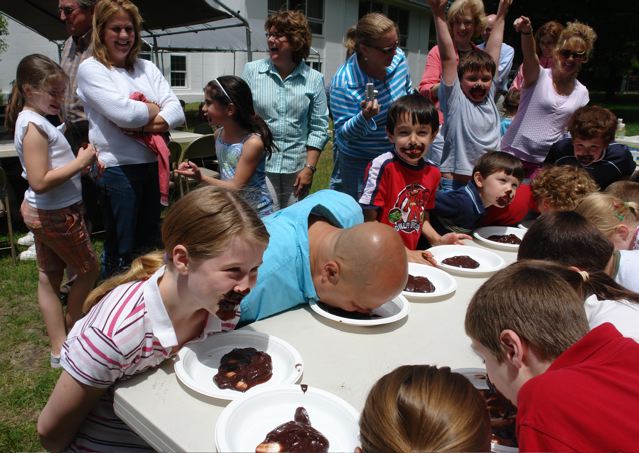
Church life in New England has a different rhythm than Baptist life in Texas. Summer time in Baptist youth ministry was busy time: we geared up for camp and all kinds of special activities. Summer in New England means life slows way down. We move to an abbreviated summer worship service without Sunday School and most committees take a break for a month or two. It is often said that even God goes to Cape Cod for the summer. Children’s Day marks the end of the regular church year. Part of our tradition is an all-church picnic after worship. Along with burgers and hotdogs, there are sack races, an egg toss, and a pudding eating contest.

We had a perfect day for our picnic and, for a couple of hours, we all got to step out of time and enjoy being together in a wide spot of our own on time’s road, equally sacred but a little messier.

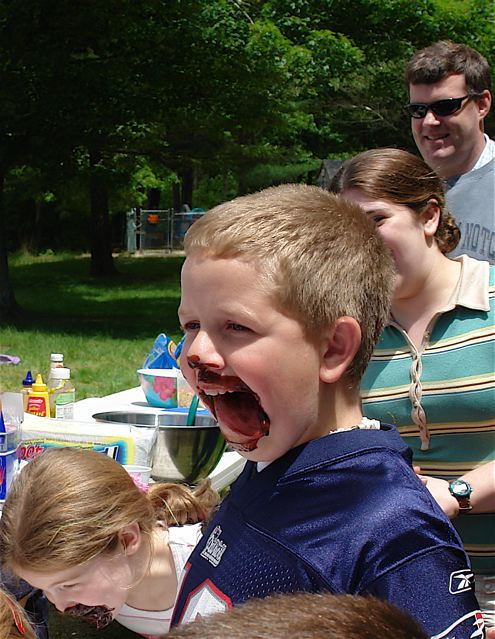
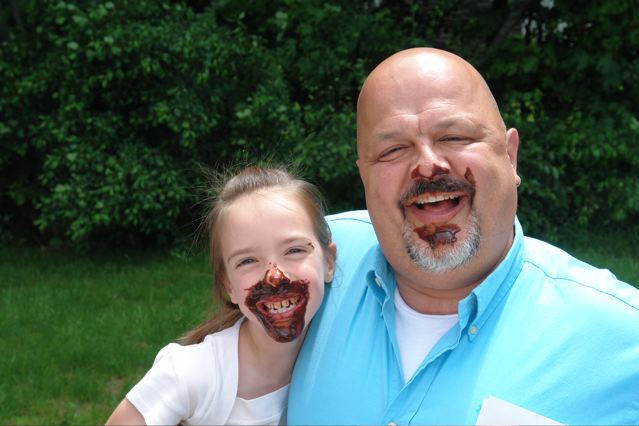
As the pudding eating contest began, the kids gathered around a table lined with plastic plates, each one holding a glob of pudding. The challenge was to snarf the pudding without using your hands. Some kids were pudding high just standing next tot he table; others had to kneel to get to the proper height. Once they all got going, I noticed an untouched plate at the table and I couldn’t resist. I dropped to my knees and began to do some snarfing of my own. I didn’t care about winning. I did care about eating pudding and getting to feel the joyful abandon I saw on the chocolate covered faces of the kids at the table.

It worked.

After the picnic, I came home and crashed for a couple of hours in front of a Red Sox game and then stopped by a graduation party for one of the seniors in our youth group before going to Senior High Fellowship, our Sunday night high school gathering. Andy was the guest of honor at the graduation party. His family and friends filled up his backyard to mark his milestone with him, much as Rachel and Reuben’s folks had gathered with them only a couple of nights before. I was glad I got to be there, too.

These are days that don’t afford me much more than drive-by sacredness. I feel as though I’m passing through these moments rather than being in them, in some sense, even as I’ve been able to share In the celebration and joy. Just over a month ago we were tromping through Greece and Turkey, living days that were clocks without hands, resting in the layers of history that surrounded us, with time to both be present and reflect on what was happening to us.

I’m grateful to have been able to live those days.

I’m also grateful for these days, packed with everything from t-shirt orders to tomato plants, pudding to Pentecost, Boston to Birmingham. God shows up in everything from fiery pillars to still, small voices – even flesh and bone. As I bounce back and forth, I keep reminding myself – and keep asking to be reminded – that grace travels well at any speed.

Peace,
Milton

Wednesday, June 07, 2006

sometimes a light surprises

I’m going to start with a nod to a friend that I don’t want to get lost at the end of the post. My friend, Nathan Brown, whose poetry I have quoted a couple of times, has a website where you can find his work and contact him. Check it out at www.brownlines.com.

___________________________________

Today has surprised me.

This was going to be the day I finished the details for Mission Trip, planted my tomatoes and herbs, and got ready to head out for Birmingham tomorrow to celebrate my in-laws’ fiftieth wedding anniversary on Friday (I’m the caterer). Items one and three are still on schedule, but a raging rainstorm has kept me out of the garden and tucked inside the house with the Schnauzers. Ginger is already in Alabama and called this morning with a list of songs for me to create a mix CD for the party. Her folks were calling out song titles in the background. After I hung up, I set iTunes searching for Eddy Arnold, Hank Williams, Roger Miller, Patsy Cline, and Alan Jackson.

Hearing some of those songs opened up memories I had not touched in years.

“Little Green Apples” was one of my father’s favorite songs when I was a kid. We had the Roger Miller version. In what may have been my first encounter with cover songs, I heard O.C. Smith sing it at a friend’s house one day and changed what I thought about the song. I found both versions today. I already had Ray Charles singing “I Can’t Stop Loving You.” I chased down “Put Your Head on My Shoulder” (Paul Anka), “Over the Rainbow” (Judy Garland), “The Way You Look Tonight” (Tony Bennett), “Hey, Good Lookin’” (Hank Williams), “Tall, Tall Trees” (Roger Miller), “Cattle Call” (Eddy Arnold) and “All Shook Up” (Elvis). I also downloaded “Remember When” by Alan Jackson, at my mother-in-law’s request.

When iTunes showed my all the songs by Alan Jackson, I saw he had recently released a CD of hymns. The songs he chose are ones deeply imbedded in my bones from years of singing them in Baptist churches. I clicked on a couple of them to hear the previews and before long I sent my ten bucks through cyberspace to but the whole record. He’s been singing in the background ever since. The songs take me back to Sunday night services where we got to call out hymn numbers and sing favorites for half of the service. Those songs are what taught me how to harmonize, how to feel moved by the Spirit, and how to love going to church. They also taught me to look beyond the familiar tunes for other songs. One I found as we sang one night was William Cowper’s hymn, “Sometimes a Light Surprises”:

Sometimes a light surprises the Christian while he sings;
It is the Lord, who rises with healing in his wings:
When comforts are declining, he grants the soul again
A season of clear shining, to cheer it after rain.
One this day of rain, I did find a season of clear in those songs.

Faith is funny sometimes. There are good reasons why I don’t sit in Baptist services on a regular basis. As my journey going from God to God has unfolded, I’ve found a home in the UCC where I am deeply fed. And I hear these songs and wish for the heart and emotion of the worship services in Baptist life where people – at least some of them – came to church expecting to be changed in the encounter. I worship each Sunday, now, with people of deep and committed faith, but we hold our emotions close. And, I have to admit, there aren’t many hymns in the New Century Hymnal designed to move people to much of anything. We have a lot to learn about congregational singing.

Once again, the Spirit moves in the creative tension between the poles. God has a better shot at my heart when I’m reaching back with one had and forward with the other; I leave myself open and unguarded. In between the raw emotion and personal sentiment of the gospel harmonies and the deliberate intentionality of a faith that pushes out into the world seeking justice are the thin places (as Marcus Borg describes) where the Spirit breaks through. Who knew, on a cloudy day when I was looking for old love songs, the guy who sang “It’s Five O’Clock Somewhere” would remind me
I love to tell the story for those who know it best
Seem hungering and thirsting to hear it like the rest.
The gospel song that moves me most is “His Eye is on the Sparrow.”
I sing because I’m happy
I sing because I’m free
His eye is on the sparrow
And I know he watches me
I’m writing today to capture a moment more than make a point. A song blew in with the storm today and surprised me.

Feel free to sing along.

Peace,
Milton

PS -- I'm off to Birmingham tomorrow and will be back late Saturday. You'll hear from me again Sunday or Monday.

Monday, June 05, 2006

keeping up

Back in March, I added a third page to this blog called “don’t eat alone: the possibilities.” The idea grew out of my writing about the connection between cocoa harvesting and child slavery. When I first wrote about it, I generated a good bit of conversation. By the end of March, I wondered how to keep it from falling out of view. I thought I could keep issues closer to the front by giving them their own page and highlighting stuff I came across. It was a good idea and I couldn’t pull it off. I pulled the site down and will speak to the issues here as they come up.

I don’t want to forget what’s important, or be a slave to the immediate, and I have to come to terms with my limitations. As much as I would love to champion most every cause I come across, I can’t do it. There are too many important things for me to keep track of them all. That’s a hard truth for me to face.

I was in the car briefly this afternoon and heard the folks on NPR mention that this week is National Headache Awareness Week and June is National Accordion Awareness Month. When I got home, I searched for more accordion information and found those events are only two in a long list. In case you were wondering, June is:

Accordion Awareness Month, National (here’s to Flaco Jimenez)
Adopt-A-Shelter-Cat Month
Aphasia Awareness Month, National
Cancer from the Sun Month
Candy Month, National
Child Vision Awareness Month
Children's Awareness Month
Dairy Alternatives Month
Effective Communications Month
Entrepreneurs "Do It Yourself" Marketing Month
Fight the Filthy Fly Month (as opposed to the clean fly)
Fireworks Safety Month (so you can go nuts in July)
Fresh Fruit and Vegetables Month
GLBT Book Month, National
Iced Tea Month, National
Dairy Month (what about the dairy alternative?)
Perennial Gardening Month
Turkey Lovers' Month (or how to sell turkeys in June)
Men's Month, Intl (we need a special month?)
Pharmacists Declare War on Alcoholism (they’re bringing in the National Guard)
Potty Training Awareness Month
Professional Wellness Month
Rebuild Your Life Month (I only get a month!)
Rivers Month, National
Rose Month, National
Safety Month, National
Scleroderma Awareness Month
Soul Food Month, National (now we’re talking)
Sports America Kids Month
Steakhouse Month, National
Student Safety Month
Vision Research Month
Zoo & Aquarium Month (go pet a penguin)
If that’s not enough, this week is:
National Headache Awareness Week
International Volunteers Week
National Step Parents Week
National Fishing Week (go fish, your headache will feel better)
And today is:
Day Against Drug Abuse & Trafficking
National Hunger Awareness Day
National Gingerbread Day (tomorrow is applesauce day)
World Environment Day
Richard Scarry Day (I have no idea . . .)
Teacher's Day (always the first Monday in June)
National Attitude Day (what kind of attitude?)
It’s just too much. I don’t know what else to say.

May and June are family travel months for me. I went with Ginger to Greece and Turkey to kick off her sabbatical, then to Memphis last weekend to celebrate Scott’s graduation, and this Thursday I fly to Birmingham to cook the food for a party to celebrate my in-laws’ fiftieth wedding anniversary. I’m not home between trips long enough to establish any rhythm, so I’ve turned into a hermit, going to work and coming home. I wrote only once last week. I spent a great day in the garden today building my boxes for square foot gardening. I feel as though I’m in a separate orbit from my friends, which makes it hard to find much energy for anything other than getting through my day. I don’t like feeling so disconnected.

Without much else to say except I’m aware I’m out of sync, I was determined to write today. Taking time to find a way to make words matter is a crucial touchstone for me. I need the voices that remind me there is more to life than me – even when my time fills up with my stuff – to speak louder; I also need them to remind me that, even though I can’t speak to every need, I am called to pay attention.

Peace,
Milton