I’m not one of those people who remember dreams, for the most part. Something about the way I wake up in the morning makes my mind work like an Etch-a-Sketch, erasing whatever was created during the night as I shake myself into consciousness. But I think I had a dream last night that refused to go away, one that has taken all day to break the surface, one with a haunting quality that I don’t think plans to fade away anytime soon. It’s pretty straightforward. There aren’t any symbols to unpack or metaphors to mine. I’m sharing it in search of resonance. Somewhere in the world, someone is already doing what I dreamt; I don’t have to reinvent the wheel (or the stove) to see my dream incarnated. Someone out there knows whom I need to know. Therefore, trusting in the connections of grace that bind us together, I share my dream.
I dreamt I had a restaurant – a diner, actually – that was open for lunch Monday to Friday. The inside of the place was filled with round tables that sat six or eight people. There were no tables for twos and fours. In the kitchen was a team of good cooks, people who were serious about making good food to draw people together. Each day we prepared a plate lunch: salad, entrée, sides, and dessert. The menu changed depending on what we could get our hands on to cook. Regardless of the ingredients, we made comfort food, community building food, food made to be eaten together.
The doors opened at ten-thirty or eleven, and people found a seat wherever they could as they came in. The point was to break bread with people you knew and some you didn’t: to break barriers and open hearts. When folks sat down, we brought their drinks and then started bringing their food. When the meal was over, those who could paid for lunch and those who couldn’t, well, didn’t. Some learned to give out of their abundance and paid for more than one meal without making a big deal about it. Some paid by joining the staff of the restaurant and doing what they could to help feed folks. When the food ran out, we closed the doors for the day and started working on what we were going to make the next day.
What we learned, over time, was there was a way to feed people’s hunger for food and community and make a living doing it. (Here’s where I need to know who has figured out how to actually do this.) There has to be a way to create excellent food and make it available to anyone who is hungry, not just those privileged enough to afford it. I dreamt of a place Isaiah described:
Hey there! All who are thirsty, come to the water! Are you penniless? Come anyway—buy and eat! Come, buy your drinks, buy wine and milk. Buy without money—everything's free! Why do you spend your money on junk food, your hard-earned cash on cotton candy? Listen to me, listen well: Eat only the best, fill yourself with only the finest. Pay attention, come close now, listen carefully to my life-giving, life-nourishing words. (Isaiah 55:1-5, The Message)
What I dreamt is real. Someone out there is living my dream. Please tell me who they are. I need to learn from them; I need them to feed me.
Yesterday was Ginger’s last Sunday of vacation, so I spent the morning, once more, reading Sara Miles. The heart of her book is about starting a food pantry at her church in San Francisco. In the process of telling her story, she says some profound and confrontive things about faith and action.
As a grateful member of the United Church of Christ, I’m a part of a denomination that willingly owns the labels “liberal” and “progressive.” Words like justice, peace, and inclusiveness are a regular part of our vocabulary. Someone has said if Christianity were a neighborhood, the UCC would be the last house on the left. When I read about Miles’ Episcopal church in San Francisco, I imagine her congregation is not so different from the ones I’ve known in the UCC: mostly well-off and well-intentioned white people whose faith matters to them and who as averse to being made uncomfortable by their faith as anyone else. I think we do want our faith to matter to us and what we do with our lives to matter to God and to others, and it’s hard to break out of our patterns of faith, action, and relationship to be converted and transformed by the Spirit.
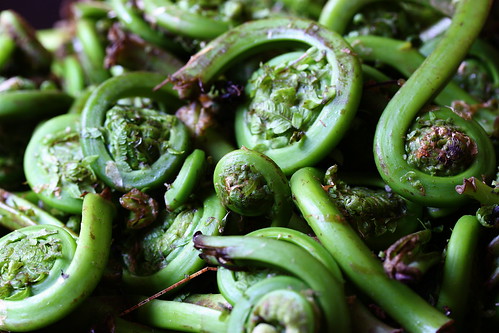
As Miles talked about the growing pains and gains of the food pantry, she said, “We were all converting: turning into new people as we rubbed up against each other” (138). I immediately thought of fiddlehead ferns. (Didn’t you?) To clean fiddleheads before you cook them, you put them in water and rub them up against each other. The dark outer layer – dirt, skin, whatever – comes off leaving a beautifully bright green skin that sparkles in the sauté pan. They don’t clean up well one by one; they have to rub up against each other to be transformed.
As she began to get to know the people who came to the food pantry and then volunteered to help run it, Miles writes,
Where had all the people like Nirmala been, all the years that St. Gregory’s was holding services and trying to entice worshippers, one or two at a time, into the experimental liturgy?
The people who came to get food at the pantry had been, to regular middle-class churchgoers, basically like Jesus – that is, invisible. We knew they were there, but we couldn’t see them, and their sufferings and loveliness were imagined, not incarnate in a specific body.
But as I got to know them, I started to ee more clearly now the people who came to the pantry were like me: messed up, often prickly or difficult, yearning for friendship. I saw how they were hungry, the way I was. And then, I had a glimpse of them being like Jesus again: as God, made flesh and blood. (128-29)
I picked up my pen and wrote in the margin of my book, “How do we make church more physical, more visceral?”
Chef made a mistake during service last night. He knew we were going to be busier than usual for a Sunday because of the holiday weekend, but he only put one dishwasher on the schedule. Since Sunday is usually Chef’s day off and he worked, he left about eight-thirty. As Ashad and I were cleaning up after service, he commented on the huge stack of dishes that faced Leonardo, our Brazilian dishwasher who leaves work at eleven or so to go to his second all night job.
“We should help him,” Ashad said.
I finished wiping off the counters and headed back to the dish room. I started rinsing things out and stacking them so Leo could begin washing. Ashad joined in a couple of minutes later and began putting away the things that were clean. By staying an extra twenty minutes we had cleared the dish area and kept Leo from being there for a couple of extra hours. Sous saw what we were doing and had a couple of cold beers waiting for us to say thank you. It wasn’t about doing the dishes nearly as much as it was about helping Leonardo. We work together, we rub up against each other; we are being transformed.
This morning, my friend Jay, who is staying with us for the weekend, told me about a story he saw on the Today Show about an organization called Kiva that makes micro-loans to people around the world who are trying to get out of poverty. Since the organization was founded in 2005, they have loaned almost $11 million from 94,000 lenders to fund almost 15,000 loans averaging about $650 each. The repayment rate on the loans is 99.72%. The average lender gives in $25 increments. I found this Frontline documentary, which gives a more personal picture of the process:
The first week Sara Miles and her friends opened the food pantry they served thirty people. Now, on average, they serve 500 families a week. The food is set up in the sanctuary of the church and people come in, ten at a time, with grocery sacks and “shop” for what they want. The pantry is staffed almost completely by people who were once standing in line to get food. They have become “The Church of the One True Sack,” as she calls it. Miles, again:
This is what gets left out, I was realizing: not just left out of the national public debate but also left out of religious discourse. Politicians talked about welfare – usually to blame and scapegoat – and occasionally made speeches about poverty. There was no shortage of talk about the poor and social service from church leaders off all stripes. But the experiences of people such as my volunteers, the texture and specificity of their incarnate lives, were missing from the story of what Christianity was like now in contemporary America . . .
The thing that astonished me sometimes – listening to tales of terrible damage, psychosis, loss – was not how messed up people could be but how resilient; how, in the depths of suffering, they found ways to adapt and continue . . .
You can’t hope to see God without opening yourself to all God’s creation. (216-17)
At the last church I served, as part of my sermon one Sunday I had people get up and physically change seats as a way of encouraging them to find a new perspective. At deacons’ meeting the next week, one person was less than complimentary of the sermon. “I don’t do come to church to be made uncomfortable,” she said.
As easy as it is to demonize her, when I look at my life I have to admit I understand her sentiment. It’s hard to come to terms with the fact that a truly incarnational faith is messy work. Bumping up against one another is uncomfortable, even painful. Christianity would be easier if it were only about ideas and concepts. Perhaps that’s why we emphasize and fight over orthodoxy more than orthopraxy. It’s not so much about believing the right things as it is doing the true things:
Feed my sheep. Bear one another’s burdens. Forgive and forgive and forgive. Love one another.
The first time Ginger and I came to Boston together was in May of 1989. We had been dating a little over four months. I attended a youth ministry seminar at Princeton Seminary and tacked on a week of vacation so I could hang out in Beantown. My mother was so excited that I was dating someone that she gave Ginger frequent flyer miles to come meet me here. We had friends who lived just outside the city and we stayed with them. Ginger left on Sunday morning and I was not going home until Monday. After I took her to the airport, I rode the T (our subway) back to Park Street Station and came up into the middle of some sort of giant celebration, which I soon found out was The Walk for Hunger, a longstanding Boston tradition. I bought a T-shirt (my default purchase most anywhere I am) and got Ginger some shoestrings for her high tops. Then I sat down on the grass of Boston Common and watched the people cross the finish line.
Today marked the tenth time Ginger and I have joined the walk since we moved to New England. According to the web site, over 43,000 people walked today. Here’s the real kicker: it’s a twenty mile walk. The main reason we have not walked more often is it’s always on the first Sunday in May and begins around seven or eight in the morning. When Ginger was serving the church in Winchester, she came up with the idea of a “worshippers’ walk” to allow us to keep our commitment to church and to social justice in our community, asking people to pledge as they would for someone doing all twenty miles. After our service, we would take a bus to Newton Corners and join the walk with about eleven miles to go. As Ginger loves to point out, my favorite thing to do is walk far enough away from the bus to not be connected to it and then say, “Man, this is great; I hardly feel like I’ve been walking at all,” as we join the folks who’ve already got nine miles behind them. It cracks me up every year.
Ginger brought the tradition with her to Marshfield and we have a regular group that walks every year. With the exception of our being in Turkey during May last year, she and I have been on every Walk since we moved to the South Shore. Our regular crew went without us last year. One of them reminded us today that ten walks means we’ve logged a hundred miles in our fight against hunger in Eastern Massachusetts. And we were in good company. The seemingly endless train of people was as diverse as their fashion senses. We saw girls walking arm in arm, sharing the headphones on a single iPod, groups from both urban and suburban schools and churches, parents pushing strollers, families marking a tradition together, and some folks just walking by themselves for the cause. I learned after we finished the walk today that the Project Bread people have also become more tech savvy, making it possible for people to gather contributions on line. If you would like to contribute to my walk, you can do so here.
Ginger and I try to walk together as often as we can. We don’t go eleven miles everyday, but we do have a pretty good three and a half mile loop through our neighborhood, including a walk down the beach if the tide’s out. Besides the physical payoff, I’ve learned there’s something that happens when we walk and talk. Somehow the feelings I verbalize find expression in my feet as well, giving me a new sense of the word “grounded.” There is something spiritual, even visceral, that happens in the combination of physical and emotional exercise.
Maybe that’s why there are so many walks these days: organizations are looking for more than a financial connection. That the Walk for Hunger is twenty miles long is also part of both its genius and its effectiveness. You have to be serious to take it on. Even the eleven miles is a challenge. Often when we try to recruit people for our causes (or our churches) we do so by trying to show them how little what we are asking them to do will require, as if “it’s not that big a deal” is an attractive invitation. The walk has shown for almost forty years that people want to be challenged to let their compassion cost them something. As we walked on pavement and through parks, each step helped to create a grounding solidarity with the poor and hungry in our state, whose numbers are growing daily.
Ginger preached today on Jesus’ words, “Love everyone as I have loved you.” The Walk seems to me to be an incarnational example of his command. Love that has hands and feet can make a difference. We walked and talked and laughed and ached and rubbed blisters on our feet so someone else who is hungry could eat. Each step grounded us in the earth beneath our feet and the grace that undergirds all of creation.
Not bad for a Sunday afternoon stroll.
Peace, Milton
PS -- Project Bread has a sense of humor, too. Here's a clip from The Daily Show they have on their web site.