Showing posts with label light. Show all posts

Sunday, February 26, 2012

lenten journal: "you are the light of the world"

Ginger preached from the lectionary passage this morning. Here's what I brought home.

“you are the light of the world”
I know were talking
about the difference
between daylight
and dark however
you of all people
ought to be able
to make room for
a little poetic license
I know about the dark
but today when I
heard your words
I thought of those
who claim to speak
for you in public
but they spew stones
and throw their weight
around to do damage
and your familiar call
had a new ring:
you didn’t call us
to be the heavy
Peace,
Milton

Monday, January 03, 2011

index of favorite lines

Here’s what happened Sunday.

Ginger had the congregation read John 1 in unison:

In the beginning was the Word, and the Word was with God, and the Word was God. He was in the beginning with God. All things were made through him, and without him was not any thing made that was made. In him was life, and the life was the light of men. The light shines in the darkness, and the darkness has not overcome it.
The last line is one of my favorite in all of the gospels. I remember it the way I learned it years ago: the light shines in the darkness and the darkness cannot put it out.

As we read, I was struck by the notion that John and his readers knew more about darkness than you or I do. Light, in John’s time, constituted of oil lamps and, well, starlight – the ones we can’t see much of anymore because of our manufactured illumination. In a world where lamps burned out nightly, John talked about what was inextinguishable: the same inexhaustible, ancient light the Magi followed was born into a baby boy who would become the Light of the World: light as old as creation, filled with the love of our inescapable God, found focus in the insignificance of an infant.

OK, I need to back up a bit. On the way to church on Sunday, as I was preparing to follow the Magi to the manger, this story was delivered without irony on NPR:
America's space program is scheduled to undergo a fundamental shift in 2011. Unless something changes by the end of the year, NASA will no longer have a rocket to send astronauts into space. The space shuttle program is being retired, and for the moment there is no American replacement rocket capable of sending people into orbit.
As we watched the wise men follow the star to the manger, the news came that we have quit chasing stars. (I know that’s not really what NASA was saying, but you have to give me a little poetic license.) In a year when we “discovered” more stars than we had previously imagined, we appear to have grown more provincial. The technological boom is in smart phones, not space craft. I have forty-seven ways to announce my every move to the world, yet, to borrow from my favorite F. Scott Fitzgerald line, our count of enchanted objects continues to be diminished. Are we are losing our capacity for wonder, and to wonder?

Now – back to church and the rest of the gospel reading from Sunday:
There was a man sent from God, whose name was John. He came as a witness, to bear witness about the light, that all might believe through him. He was not the light, but came to bear witness about the light.
One last bit of time travel: on Friday, Talk of the Nation: Science Friday was going down their list of the top science stories of 2010 and one of the guests mentioned the discovery of extrasolar planets. Though we are not taking to flight very much, the Kepler spacecraft keeps looking for “dips in starlight”
that indicate the passage of planets, had found a whopping 706 candidate bodies by June, bringing the total of presumed extrasolar worlds to well over 1,000. One of Kepler’s discoveries, though much too close to its parent star to support life, has a diameter only about twice that of Earth. The finding demonstrates Kepler’s potential for finding Earth-sized planets.
What intrigued me most was the discussion about how the planets were discovered. The “dips in starlight” were the shadows cast by the small celestial bodies crossing in front of their larger and brighter partners. The planets were recognized by their insignificance – and the light to which they pointed, much like John and the star that led the wise men.

I got to sing in church on Sunday. I sang a duet of Steve Earle’s Christmas song, “Nothing But a Child.” The last verse says,
now all around the world, in every little town
everyday is heard a precious little sound
and every mother kind and every father proud
looks down in awe to find another chance allowed
The last line -- another favorite -- gets me, whether I’m listening to or singing the song. Earle wrote and recorded it as he was falling victim to his addictions and before he went to prison for his heroin habit. The light shines in the darkness . . . .

There is, as we say in the UCC, more light still to break forth. Let’s go out into the dark and wait for it.

Peace,
Milton

Tuesday, December 14, 2010

advent journal: get yourself awed

300,000,000,000,000,000,000,000

No, that’s not my salary offer to pitch next year, nor is it the number of Cheetos I have consumed in my life time. 300 sextillion is the latest estimate of the number of stars in the universe, which is three times what astronomers had previously thought. As we learned from Hubble’s “Deep Field” pictures, every time we look out into the darkness, we find more light.

Or, perhaps, it’s the other way round.

The story is not new, but I thought about it again today because of another NPR story on Voyager 1, a spacecraft launched in 1977 to look at the moons of Jupiter and Saturn, which is getting close to the outer edge of our solar system and will move on into interstellar space in about four years. Melissa Block talked to astrophysicist Neil deGrasse Tyson of the Hayden Planetarium and asked him what had been the most amazing thing he had learned from Voyager and he talked about seeing the moons of Jupiter and Saturn. The images were clear enough to see mountains and ice. They aren’t just big balls of gas, he said, they are worlds.

As I meandered the web before I started to write, my friend Sonya pointed me to this article by Mark Morford that talked about the sextillion stars and finished with one other thing:

Oh and BTW? 300 sextillion, says our sly scientist, also happens to be the rough sum total of all cells inhabiting all human bodies on planet earth at this particular moment. One sextillion stars, one sextillion cells. Isn't that fascinating? Isn't that an odd coincidence?


Well, no, say the wise ones. Not really. Now pipe down and get yourself awed.
I put it all together and I come up singing hymns:
O Lord my God when I in awesome wonder
consider all the worlds thy hands hath made
I see the stars I hear the rolling thunder
thy power throughout the universe displayed
then sings my soul . . .
On the continuum of wonder, we sit somewhere between the two sextillions, cellular and celestial, stealthily bombarded with opportunities for amazement from both directions, even as we, the inhabitants of this world, are consumed by our fears and distractions, along with our ever-expanding sense of ourselves. Yet, the sum of all our arrogance doesn’t come close to 300 sextillion ramekins of rage (or whatever the measurement might be); our fear stands dwarfed by the brilliance bound for us at the speed of, well, light.

Maybe that’s why every time an angel shows up in the gospels he leads with, “Do not be afraid.”

Yes, it’s dark out there and, as David Wilcox says, “there’ll always be some crazy with an army or a knife.” But all the IEDs and RPGs, all the cancers and car crashes, the Alzheimers, all the terrorists and tsunamis, all the smart bombs and stupid politicians, all the wars and rumors of wars don’t come close to outnumbering the 300 sextillion stars – the light gaining on us – and all the cells that are our built-in reminder of what has been true since Creation: nothing can separate us from the love of God.

Bill Mallonee has a song called “Look at All the Stars.” The last two verses say:
there are some who’re blind by choice
and there others who are not
and I’ve kept so many faces
but my own I’ve long forgot
father often took me here
he was like a little child
long before the lights went out
I can still see him smile
he said look at all the stars
oh my look at all the stars
yeah I brought you here to see
all the things I never see
brought you to this highest peak
so you’ll me what I’m missing
when the clouds are blown apart
I hear the moon shines like a cup
in that silver velvet blue
the heart of God it opens up
look at all the stars
you say look at all the stars
oh my look at all the stars
Pipe down and get yourself awed: say, “Oh, my, look at all the stars.”

Peace,
Milton

Tuesday, April 13, 2010

morning has broken

I have to admit I didn’t know it was a hymn the first time I heard it.

I was in tenth grade, living in Fort Worth, Texas during our year of leave from the mission field (as they used to say) and completely taken with American popular radio. It was the year of “American Pie” and “I’ll Take You There,” and “Morning Has Broken.” By the time I knew it was a hymn, it had also become the wake up music for any number of youth camps, beginning (for me, anyway) with First Baptist Richardson at Camp Ozark when Gene Wilkes and I would do a less than reverent, but nonetheless sacred version to call the young campers out into the day we had planned for them.

Our version broke morning wide open, I must say.

Last Sunday morning, the hymn broke in on me as I sat among our faithful to hear the first of the “Stories of Resurrection” we had been promised on the Sundays from Easter to Pentecost. We’re going off lectionary to look at particular stories both in scripture and in the world around us here in Durham. This week it was the Gospel According to Housing For New Hope, an amazing organization here that reaches out to homeless folks with tenacity and redemption. Three people told their stories and two others sang in between tales, ending with Terry, the founder and a church member and the best damn harmonica player I know, calling us all home with a medley of “Precious Lord” and “O When the Saints Go Marching In.”

And just before they began telling their stories we sang,

morning has broken like the first morning
blackbird has spoken like the first bird
praise for the singing praise for the morning
praise for them springing fresh from the word
It was also just after Suzanne, one of our church members who is a member of the Biblical Storytellers, delivered the story of Jesus and Peter at breakfast from memory and with meaning. The story is one of my favorites from the gospels. Peter, still despondent from his failure in the courtyard, had been fishing all night with his friends when Jesus called out to them from the shoreline. When Peter realized who was calling, he shucked whatever clothing he had and swam to shore, coming up in need of a robe and redemption, and probably in that order.

With the scene in my head as we began singing, I jotted down,
morning has broken
broken open –
like an egg
or heart
broken through
like a prisoner
or a prayer
darkness falls
but morning breaks
Peter at breakfast
broke like the morning
“yes, Lord, you know
I love you”
every day we live
is broken
before it starts
About the time I finished scribbling, we got to the third verse:
mine is the sunlight mine is the morning
born of the one light eden saw play
praise with elation praise every morning
God’s recreation of the new day
When Cat Steven’s sings it, he pronounces the second word in the final line with a short e, the way we say the word when we mean something we do for fun rather than meaning to create over again. Though we usually sing the second meaning in church, it seems, I think Cat is on to something: God at play. At its very core, its very essence, creation is a reflection of God having fun.

I am in the process of becoming a morning person again, now that I am back teaching. I haven’t stopped being a night owl, which is causing some issues when it comes to getting enough sleep, but I am seeing more of morning than I have in a long, long time. I walked out into a beautiful spring morning and couldn’t help but find the hymn again as I walked to my car. I’m not sure what clicked – maybe it’s the part about being on my way to teaching English – but I realized the song was not about morning being broken, but about morning having broken, as in having broken through.
darkness falls
but morning breaks through
The day is not what is broken, but what does the breaking, scattering chards of darkness all over the place. Morning has broken like that first morning when God said, “Let there be light,” accompanied by a giant belly laugh with enough playful energy to burst that first dawn into existence. When it comes to playing, God means business. The juke box in my mind switched to Michael Been and The Call:
here’s to the babies in a brand new world
here’s to the beauty of the stars
here’s to the travelers on the open road
here’s to the dreamers in the bars
here’s to the teachers in the crowded rooms
here’s to the workers in the fields
here’s to the preachers of the sacred words
here’s to the drivers at the wheel
here’s to you my little love
with blessings from above
now let the day begin
There are days we break through or in or out, and then there are days we end up broken on the beach, like Peter, hoping for forgiveness and maybe some breakfast. Either way, most every day holds its share of broken places, as Leonard Cohen reminds us.
ring the bells that still can ring
forget your perfect offering
there is a crack in everything
that’s how the light gets in
May it dawn on us that we belong to a God whose love and laughter are deep enough to fuel suns and forgive stumbling saints who wash up on the beach at breakfast, or stuck in traffic, or standing in line at Starbucks.

Here’s to you, my little love, with blessings from above.

Peace,
Milton

Tuesday, December 01, 2009

advent journal: walking after midnight

When I got home from work Sunday night, Ginger and I took our two Schnauzers, Lola and Ella, for a walk around the neighborhood. We have to go late because Lola is not much of a people person and does better on dark and quiet streets. More nights than not, I sing a little Patsy Cline as we head out: “I’m going walkin’ after midnight” The four of us have a rather settled path, walking down to the end of our street (past Harper Lee’s house – yes, there really is a kid on our street named Harper Lee), turning in front of the North Carolina School for Science and Math, then back down Ninth Street, past the house where I think Boo Radley lives and then the fire station, then left on Englewood, and left again on Iredell and back home. As we passed Boo’s house, Ginger said, “Look,” and there was Orion, hunting over the rooftops.

I won’t even claim to be an amateur astronomer, but I can recognize a couple of constellations. I can find Cassiopeia (thanks to two John Cusak movies, The Sure Thing, first, and then Serendipity), and I know Orion, the Hunter. Almost two decades in New England meant winter was coming when he began to appear in the night sky, his belt shining through even the city lights. This morning, in my pre-kitchen reading, Chet Raymo, a real astronomer, gave me more to ponder:

Giant Orion: boaster, beast-slayer, storm-bringer. Muscle-bulging constellation of the lights. No other part of the night sky visible to northern observers contains more brilliant stars. Here is diamond Rigel, the giant’s forward foot, and ruby Betelgeuse, in the shoulder of the raised arm. Here are glittering Saiph and Bellatrix, the other foot and other shoulder, and Alnitak, Alnilam, and Mintaka, the white pearls of the hunter’s belt. Bellatrix is the closest of these stars, but at 470 light-years away it is a hundred times more distant than our nearest stellar neighbors. Saiph is 2000 light-years away. These are the giants of the Galaxy, stars ten thousand times brighter than our sun, the largest and most intrinsically luminous stars of the night. (14)
I was taught to look at the stars that we call Orion as a group gathered together in wonder and imagination. I have learned that what I see is far from cohesive. The light I saw coming from Saiph Sunday night was more than fifteen hundred light years older than that coming from Bellatrix, even though I took it all in at once. Betelgeuse is five hundred light years away; Raymo says an “average-sized star” like our sun would not even be visible to the eye from that distance. (Just think of the light we are not seeing as we gaze into the night sky.) He goes into more detail about the information astronomers are learning from new telescope images that
have only recently arrived on our doorstep to tell us that Betelgeuse is a distended giant star, a sphere of hydrogen and helium 400 million miles in deameter, swelling with a violence that consumes planets and lights up dusky corners of the Galaxy. Its surface roils like a sea in a storm, and a froth of fire is flung ten million miles into space. In Earth’s sky this monstrous object is reduced to a point of light in Orion’s shoulder. The stars are good at hiding their true natures. They have a trick up their sleeve, and that trick is distance. (16-17)
I read that last sentence and I couldn’t help but begin to hear Julie Gold’s words (sung in my head by Nanci Griffith):
from a distance the earth looks blue and green
and the snow-capped mountains white
It’s the next verse that gets me, however.
from a distance we are instruments
marching in a common band
playing songs of home, playing songs of peace
they're the songs of every man
And then she sings,
God is watching us, God is watching us
God is watching us from a distance
The truth at the heart of this season speaks otherwise. The Love as old and bright as the most ancient of stars is racing across galaxies to find us. “The people who walk in darkness have seen a great light,” Isaiah said, and John followed, “The light shines in the darkness and the darkness cannot put it out.” Distance is not the trick in the Incarnation, nor is the Coming Child something Other than the true nature of God. The trick is beyond the distance, in the drawing near. The Light and Love of God are landing among us, not with meteoric force, but quietly and subversively, in a manger, in the darkness on the edge of town.

“You shall call him ‘Emmanuel,’” said the Angel, “which means, ‘God With Us.’”

Scout’s fear disappeared when Boo Radley got close enough to save her life and she saw him, as we say, in new light. The starshine from Saiph, Orion’s back foot, that found us on the sidewalk Sunday night was old light as old as Christmas itself, having traveled over two millennia to find us. And in that light, Patsy Cline sounds like she’s singing an Advent hymn of her own:
I go out walkin'
after midnight
out in the starlight
just hoping you may be
somewhere walkin'
after midnight
searching for me
Even Lola knows you have to go out in the dark if you want to see the stars.

Peace,
Milton

Saturday, November 07, 2009

best lights

It’s not so much the words
as the way they sometimes
line up, the way they are
placed on the page --
single syllables can speak,
tear open false healings,
deep calling to deep
with faith and familiarity
both brand new and ages old.
I saw these four words:
our own best lights
at the tail end of a sentence
about being true

and I wondered where
my best lights had gone,
why I become too easily
accustomed to beams
buried under bushel baskets
of daily living, how I can
forget what brightness is,
how easily dim becomes
the definition of normal.
Yet, found by four small
words, I remember the light
shines in the darkness and
the darkness cannot put it out.

Peace,
Milton

Wednesday, December 19, 2007

advent journal: refracting hope

I worked lunch at the restaurant, which means I was up early and in the kitchen by eight this morning. When the alarm went off and I stumbled into the bathroom to put in my contacts, I found my left eye was not yet recovered from whatever irritated it last night and the contacts were going to stay in the case rather than caressing my corneas. It was at this point that the fact I packed my prescription eyewear in a place I don’t recall became more significant than it has up until now. I had to go to work – in the kitchen – in all my nearsightedness. I knew I could read the tickets and keep from cutting myself, but everything else would be out of focus.

And that’s how I felt all day long: out of focus.

I had already finished chopping the herbs for the Russian dressing when one of the other cooks said, “Doesn’t the recipe call for parsley?” I had chopped cilantro. I know the difference between the two by smell as much as sight, but I just missed it. I felt awkward in the very room where I am usually most comfortable. I was without confidence doing what I know I do well. I felt out of sync, out of rhythm, out of focus.

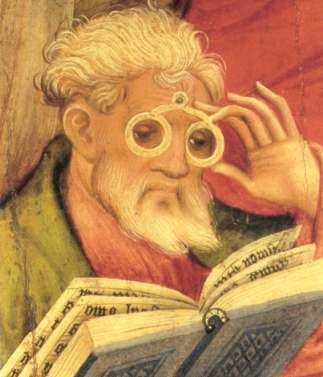
I drove home (yes, I drove carefully) wondering what life was like when no one knew how to correct vision. Eyeglasses, as we know them, didn’t begin to come into being until late in the thirteenth century. For all of human history before then, people had to live with their eyes the way they were. Their vision couldn’t be corrected.

I think it’s interesting we use that verb to describe how we help someone see. We don’t heal or adjust; we correct. As a former English teacher, I corrected more papers than I can remember, or wanted to correct for that matter. In the context of the classroom, correct meant pointing out what was wrong: “to point out or mark the errors in,” the dictionary says. The vision version of the verb isn’t about pointing out the errors as it is “to set or make true, accurate, or right.” Simply put, my contacts (and my glasses, when I find them) let me truly see. What the lenses do, in my limited understanding, is refract the light, or bend it so it hits my eye at a different angle, thus allowing me to see what’s in front of me.

I got home from work late this afternoon in time to throw a soup together for our potluck before our Blue Christmas service, which is a refraction of sorts, bending the light of the season to let our sorrows stand in full view. The sanctuary was dressed in candlelight as eleven or twelve of us gathered to help one another see more truly what it means that Christ is being born again in our time. We sang:

what can I give him, poor as I am
if I were a shepherd, I would bring a lamb
if I were a wise man, I would do my part
but what I have to give, I will give my heart
At the front of the church was a Christmas place setting. When we came into the service, we were given small place cards and then invited to write who and what we miss this Christmas. We then came forward and placed our cards at the table as we heard
the depth of God’s love reaches down, down, down
to where we are until we’re found, found, found
a quiet word or none at all pursues the heart behind the wall
and to those who wait with darkness all around
the depth of God’s love reaches down
At the close of the service, Ginger invited us to come forward and stand in a circle around the empty place setting, now surrounded with the small cards. “Take your left hand and place it over your heart,” she said. “Now take your right hand and place it on the back of the person next to you.” As our hands moved, we refracted the love of God one to another, allowing us to see truly we were not alone, even in our grief.

While I was waiting on the soup to finish before I went to church, I decided to try my contacts again. Whatever had irritated my eye was gone and I could see. When the service was over, I had much the same feeling. My part tonight was to sing Andrew Peterson’s “After the Last Tear Falls.” The bridge says:
and in the end, the end is oceans
and oceans of love and love again
we’ll see how the tears that have fallen
were caught in the palms
of the Giver of Love and the Lover of All
and look back on these tears as old tales
because after the last tear falls
there is love, love, love, love
there is love
John says, in one of my favorite verses, “The light shines in the darkness and the darkness cannot put it out.” Tonight, I beg a bit of a paraphrase:

The light bends in the darkness and the darkness cannot keep us from truly seeing.

Peace,
Milton

Saturday, April 07, 2007

lenten journal: dawn on me

I see more sunsets than sunrises at this stage of my life.

Tonight, I stepped out of the kitchen to take a short break just as the sun had disappeared below the horizon. Just above the silhouettes of the rooftops, the sky was still bright, but as my eye moved upward the brightness turned to a burnished orange and then through whatever spectrum of shades it takes to get to azure blue. From the azure, the blue deepened, as if my eye were sinking into the depths of the ocean rather than the expanse of the sky, until the blue was black enough for the stars to shine. Night fell softly like snow or a gentle rain rather than a guillotine.

Daylight comes the same way, just in reverse.

Most of the nights during Lent have required of me to write in the dregs of the day, so I’m usually under a deadline since we choose to say our days begin once the clock strikes twelve. The reason our days begin then is it was the only way to standardize time – or so said Sir Sanford Fleming, who developed the idea so trains could run efficiently. To standardize things required an arbitrary starting point: midnight. We‘ve continued to play with our clocks over the years, acting as if we can make time do what we say, but a day doesn’t begin in the middle of the night.

My days usually begin with Gracie, our youngest Schnauzer, pawing at my head to wake me up. If that doesn’t work, she lets out one pointed yelp right in my ear and then licks me when my eyes open. All of this happens somewhere between six-thirty and seven. As the days grow longer, her paw will move into action earlier, I assure you. Summertime around here means the windows are open all through the house. Most New England homes don’t have central air, so we turn on fans and pray for a sea breeze. Those early summer mornings are filled with waking sounds of birds and waves and people in our neighborhood, all sliding gradually into the beginning of the day.

In the world Jesus knew, days began and ended at sunset. What came first everyday was rest. Or maybe they ate and then went to bed. Halfway through the day, they got up and worked and walked and did whatever they needed to do before the day was over. We think of light as the beginning of the day; for Jesus, the day began in darkness and finished with light. They ate supper first and sang lullabies first. Dawn came later.

I wonder why we changed. (Actually I kind of wonder – my comment is mostly rhetorical.)

The day was half over when Mary went to the tomb to care for Jesus’ body. I can’t imagine she had rested well. The stone had been moved and Jesus was not where they had laid him, but the light fell gradually on Mary until it dawned on her what had happened when Jesus called her name. And just as it takes a while for the morning sun to vacuum up the shadows left from the night before, so the light moved gradually across Peter and John and the other disciples, finally landing on Thomas.

One of the reasons I’m glad life circles around to the Resurrection every year is I know I need to hear the story again because there is still much about faith and life that needs to dawn on me. Here in the dead of night, halfway through the day, I’m waiting again for the dawn, for my every morning metaphor of midday sunrise, to call me again to trust and follow the Risen Christ.

And this night, most of all.

Peace,
Milton