Showing posts with label movies. Show all posts

Monday, September 07, 2009

life is an independent film

A week or so ago we did some catching up on our movies and finally saw The Visitor, an amazing and well-told story captured and the intersection of privilege and despair. I would tell you to stop and go watch it now, but I want you to read. So, finish reading and then go watch it.

The film is of the small, independent variety – Sundancey, if you will – which also means it is full of space. There is not a soundtrack that fills up every second, there are not any noticeable special effects or computer generated beings. There’s a lot of walking around and talking and just getting through life. Which led me, hot on the heels of my last post on metaphor, to this conclusion:

Life is like an independent film: low budget (at least in our case); character driven; no big stars to speak of, but a lot of people you look at and think, “I’ve seen them in something else”; and; for the most part, nothing happens. You just see their lives from Point A to Point B and then everyone goes their separate ways.

Life is a movie where nothing happens for the most part, where all the action is in the details, where we share the experience of being human at some of the most surprising intersections, where our laptops suffice for what computer generated aid we get, and where there are few special effects and even fewer stunt doubles. Somewhere in the stack of stuff that belongs to me is a greeting card with a quote by Ashleigh Brilliant (her real name) that says,

My life has a superb cast, but I just can’t figure out the plot.
Life is that kind of movie.

One of the things I love about indie films is the lack of focus on one person, usually. If we’re talking Sundance flicks, we’re talking ensemble casting: it takes a village to tell a good story. Regardless of how much the star making machinery tries to tell us who matters in the world, the great stuff doesn’t really happen on a grand scale. What matters most happens everyday, over and over: people find ways to dream dreams and love one another and build things and tear them down and hope and fail and lose and find, all in that layer of the universe where it matters if you can find a parking place, or when pay day is, or what you are having for dinner. In this movie, we are all small players with a few scenes, all of which matter because they are the story.

What does it mean to the story that I have peeled and diced more pounds of onions and carrots than I could even begin to count for soups that lasted only a day or two and then were forgotten? There’s a question underneath that one, though, that might begin to offer an answer: how did I dice and chop?

How have I grown and changed in the middle of the mirepoix? Who have I become? Have I let the details of life become drudgery that have soured me into cynicism? Do I think more about what I am doing without than who it is I am working with? Can I, as I wrote once in a song, hear the music through the circumstance, or am I simply going through the motions?

The answers are as daily as the details. It may depend on which day we’re shooting the scene, if you catch my drift. Some day the movie metaphor may fall from independent project to boring instructional video or, perhaps, absurdist foreign film. A great deal depends on how well I’m listening because that’s the first act in paying attention and responding well.

Last night at the Durham restaurant, I walked out into the dining room to get a cup of coffee. We were about twenty minutes from the end of service on what turned out to be a very busy night, and I was tired. A man and woman were being shown to their table just as I got to the coffee pot.

“How are you?” I asked.
“Ready to be impressed,” he said with a big grin.
“Cool,” I answered. “Thanks for being ready. That makes things so much easier for us.”

I already knew he was going to have a great meal because he was ready for one. And I don’t mean that simply as some sort of positive thinking projection technique to imagine my way into a new reality. What I mean is he came in expecting we were going to play the scene well. Knowing he was already pulling for us made the scene a lot easier to play. I was working on the nightly order sheets by the time they left the restaurant.

“How did we do?” I asked him.
“It was everything I expected,” he said, and we both went on to our next scenes and, not too long after, I let the credits roll on my evening.

Today at work, my phone rang about 4:30, as it does most afternoons I’m at work, because Ginger calls right before service just so we can have a chance to talk. It is one of the details that demonstrates her love for me. I know the scene by heart and I never get tired of playing it. Life is the kind of movie that gets told in those kinds of details – in calls and touches. Redemption rides on small gestures and simple acts; forgiveness has fingerprints.

Just watch this closing scene from Big Night. If you haven’t seen the movie, all you need to know is the two brothers who end up in the closing shot had both hurt each other deeply the night before. Do notice the whole five minutes is done without an edit. About as real life as it gets.


Peace,
Milton

Sunday, August 09, 2009

cleaning off my desk

I guess tonight might be the blogging equivalent of clearing off my desk.

I have not written as regularly as I would like over the last couple of months for a variety of reasons, this week however, it was not for lack of ideas. Before the time gets away, I want to comment on a couple of things and then make a request.

First, John Hughes died this week. He was the director of Ferris Bueller's Day Off, Uncle Buck, Wierd Science, Sixteen Candles, and The Breakfast Club, to name a few. As a youth minister in the 80's, I leaned into his movies to help me understand the kids in my youth group. And, for that matter, to learn a bit about myself as well. He was not the greatest director ever, yet he made movies that mattered to me and that I still watch and quote extensively.

And I would still love to know the punch line to the joke Judd Nelson was telling when he fell through the roof.

Here is a tribute montage someone else put together that is worth passing along.


Second, and leading into third, we went to see Julie and Julia last night, which is a story about blogging as much as it is about cooking and finding out what matters most.


One of the things I found in the movie was a push to figure out why I am writing these days. What I mean by that is I know why I write (because I am a writer), and I want to do more with this blog than ramble this way and that. So, the "third" in this litany is a request. I am thinking about taking on some themes -- a week, or perhaps longer for each -- and writing in a particular vein for that time to see what sort of shape my writing might take beyond my fairly regular posts, and to see what I can learn and how I can grow. Though I know the days of regular commenting on blogs has passed, I am asking for suggestions of themes or ideas you think might be worth me tackling. And we will see where it goes.

Thanks for reading.

Peace,
Milton

P. S. -- Speaking of Julia Child, I couldn't close without posting this favorite Saturday Night Live clip.

Saturday, May 23, 2009

paying attention

In life, most days, it’s not so much what happens as it is what we notice, what we choose to remember and carry with us.

A week or two ago, I noticed Julia Cameron’s The Writing Diet on the shelf at Barnes and Noble. She is the author of The Artist’s Way, a book that has been significant to me at several different junctures of my life, so I browsed through this new (to me) book and was intrigued, since she speaks to me and I’m carrying around more weight than I want to. I chose to come back to our neighborhood bookstore, The Regulator, to have them order it for me, so I didn’t get it until late last week.

One of the key components to her approach to both art and losing weight is something she calls “morning pages.” No real mystery. The name says what it is: get up in the morning and write, first thing, three pages of whatever comes out and then go on about your day. What I learned before, when I wrote every morning as I began to come to terms with my depression and as I have written now for about a week, is my early morning scribbling is a living prompt, in the same way I’ve been given writing prompts in classes over the years: a call to pay attention.

Interesting phrase, isn’t it? Pay attention.

I must pay attention in the same way, perhaps, that I paid the man at the bookstore for my inspiring little volume – give something up for something I want. If I want to pay attention to life as it happens around me, it’s going to cost me. And it’s going to pay off in ways I seldom am able to imagine. Which leads me back to my opening sentence: in life, most days, it’s not so much what happens as it is what we notice, what we choose to remember and carry with us.

I clicked over to YouTube tonight, in search of a video we had talked about at work today and found a selection of four short films from the National Film Board of Canada (gotta love those Canadians) that were competing at the Cannes Film Festival. They range in length from about two and a half minutes to a little over nine, all of them incredibly well made and imaginative. As I watched, I began to think of all the love and work and play and art and sweat and struggle and joy and hope and despair and determination that went into each of these projects, knowing full well they would only be seen by a relatively small group of people. You don’t get famous making two-minute movies.

But you can tell a great story.

And, when you find someone telling a great story you should pay attention long enough to suggest to everyone you can that they might do the same.


Peace,
Milton

Wednesday, April 15, 2009

time pieces

After walking through Lent to Easter, a journey in which time stretches out like a path leading us somewhere, I came across an interesting list yesterday of things that all happened on April 14, making time feel more like a totem or a sculpture where the different blocks are stacked one on top of the other. The list is courtesy of The Writer’s Almanac:

I’ve been turning the list over in my mind for these couple of days, intrigued by the date they share in common, these two tragedies and two births, if you will. As one who shares a birthday with Gustav Flaubert, Edvard Munch, Frank Sinatra, Dionne Warwick, Jennifer Connelly, and Yuvraj Singh, I realize grouping by a date on the calendar is rather arbitrary and I’ve stayed intrigued by what the assassination, the sinking, the birth, and the novel might have to say together.

For someone of my generation (and perhaps others, too), all four things are larger than life. So much has been written and said about Lincoln, particularly our politicians trying to claim some sort of connection, that the man we think of now when we hear his name is probably not the same man shot in the theater that night. The tragedy of the Titanic has been romanticized and retold into an epic metaphor of disaster. Anne Sullivan is the one who was able to help Helen Keller, well, become Helen Keller. And Steinbeck’s book, which is sure to see a resurgence thanks to our current economic times, gave us Tom Joad, one of the great characters of American literature (and, by the way, you can watch the whole movie here for free), and his immortal words:
I'll be all around in the dark. I'll be ever'-where - wherever you can look. Wherever there's a fight so hungry people can eat, I'll be there. Wherever there's a cop beatin' up a guy, I'll be there. I'll be in the way guys yell when they're mad - I'll be in the way kids laugh when they're hungry an' they know supper's ready. An' when the people are eatin' the stuff they raise, and livin' in the houses they build - I'll be there, too.
Here in the story of a day we see those who dreamed big, worked hard, failed enormously, died unnecessarily, and simply survived. None of the principals involved in the events I mentioned knew how the day would go. Lincoln was going to a play. Those on the Titanic were on the maiden voyage of the best ship anyone could imagine. As Anne’s parents held her, they had no idea who she would grow up to be. Steinbeck warned his publisher that the book wouldn’t be popular.

And I wonder how the rest of the days might have been different had Lincoln seen the end of the play, the Titanic finished its voyage, had Anne Sullivan not been born blind, or Steinbeck given in to his skepticism about his novel. Would Lincoln have handled Reconstruction differently? What metaphor would we use for futility instead of “rearranging the deck chairs on the Titanic”? What might have happened to Helen Keller? What else would be on high school reading lists?

But they did happen. All of them. On April 14th. And they helped to make the world what it is. And on April 15th, during the last half hour of a quieter than usual night at the restaurant, Ginger and Cherry came to dinner and Abel and I came out from the kitchen and sat with them, along with a couple of the servers, and we talked and laughed and learned a little more about each other. Our little gathering will never make The Writer’s Almanac list, but it will take its place, adding to the metaphor of time as a mosaic, each small glistening moment essential to the bigger picture.

Peace,
Milton

Saturday, November 15, 2008

comedy is empathy

Ginger and I agree on most things in life, but one of the places where we differ is our disparate opinions of The Office. She can’t stand it and it cracks me up. I’m late to the show, actually, catching up these days with through cable reruns and well aware that the original British version is probably even funnier. I thought about the show today because I heard part of an NPR interview with Ricky Gervais, the creator of both series and the star of the British version. I stepped out between two catering gigs to grab a cup of coffee and a shot of thoughtfulness thrown in for free.

Gervais has just finished a US stand up tour and was promoting an HBO special that is coming up. In the part of the interview I got to hear, he was talking a bit more philosophically about what comedy means and where it comes from. I’m fortunate that npr.org has a transcript of the part of the interview that I heard:

"America is my mecca for entertainment. Everything I have ever loved has come out of America," Gervais says. Those comics "taught me that you have to be at the bottom rung of the ladder. No one wants to see unfeasibly handsome, clever people doing things brilliantly; they want to see a putz struggling and falling over, and the important thing is getting back up again."

Gervais insists there is no place for a peacock in comedy. He says it's all about being the everyman and maintaining a fallible persona that people can relate to. "There should be no machismo in a comedian because comedy is about empathy," he says. "I think the audience doesn't need to be told that your life is better than theirs."

In Out of England, Gervais comes onstage with a king's crown and a rock star's pomp, accompanied by fireworks and Queen's "One World, One Vision." His ostentatious entrance is a tongue-in-cheek jab at production values and the idea of celebrity.

"Soon you find out that all my anecdotes of fame are about me being the underdog, me being embarrassed socially, depressed, everyone getting the better of me," he says.

Gervais says returning to stand-up has allowed him to discover the importance of physical comedy. He realized "what people liked was me acting out a scenario as opposed to just telling jokes," he says. "Because comedy is empathy, most of the things we identify with are probably nonverbal. Body language and the way that you feel things are are more important than what you hear."
Comedy is empathy. He said it twice. Comedy is empathy.

One of my favorite movies is an offbeat little comedy that was one of Luke and Owen Wilson’s first films: Bottle Rocket. The tag line to the movie was, They’re not really criminals, but everybody’s got to have a dream.” Owen plays Dignan, a lovable goof who thinks his seventy-five year plan to criminal success is the key to life. Luke plays his friend Andrew who has just been released from a psychiatric hospital. Dignan sees his plan as salvation for them both and begins to put together a team. In the scene below, he’s interviewing Bob for the position of getaway driver.


“That’s good. That’s good. ‘Cause it hits me right there.” Empathy.

In another one of my favorite movies, Dead Poets Society, Mr. Keating (Robin Williams) says to one of his students, “We’re not laughing at you; we’re laughing near you.” Comedy is empathy.

Empathy is identifying with the feelings and actions of someone else so much, as one dictionary put it, that when the batter swings the bat your muscles tense. It is identification, connectedness. The comic is not saying, “You’re like me,” but rather, “This is what it feels like to be in your skin.” Comedy is incarnational.

I loved what he said and I thought about it as I was helping to prepare dinner tonight for a roomful of people I didn’t even see. I ran through several comedians in my mind and soon realized Gervais was not describing all of the comedy there is, but what he saw as comedy at its best. He was making a bold statement in a world filled with biting and cynical satire where comedy is mostly target practice. He was offering a powerful and gentle alternative.

Though his words sent me thinking more metaphorically about comedy, particularly related to faith – Jesus as the original stand up comic – I wanted to pass along what I heard because it’s worth regarding someone who takes the time to think about what they do, about what they mean, and then moves to embody those thoughts with intentionality.

That’s good. That’s good. ‘Cause it hits me right there.

Peace,
Milton

Tuesday, January 08, 2008

ratatouille


I know I’m late to the game, but I finally saw Ratatouille Sunday night. Ginger and I watched it when I got home from work. What a wonderful movie. When I got to the restaurant this afternoon, I couldn’t help but talk about the film and the appreciation of the story of a little rat who dreamed of being a French chef was unanimous.

How can it be that the folks at Pixar could lead us to embrace as the chef an animal who is among the least appetizing of any, when we think about them being in the kitchen? This is good work and they didn’t miss a detail. The first thing Remy the rat does when he gets into the kitchen at the restaurant is wash his hands. The Little Chef, as he is called, has to convince the humans he belongs in the kitchen and convince his family he wants more out of life than scavenging for garbage.

Since we’ve not yet unpacked the remote to our DVD player, we weren’t able to watch any of the extras to find out how they researched the food side of things. What I can tell you is they were spot on in most every detail. James. one of the other chefs at work who had seen some of the extras said Thomas Keller, who owns the French Laundry and is arguably the best chef in America, consulted on the film, even to the point of letting his ratatouille be the model for the dish in the movie.

There was one moment in the film that took my breath away. The movie builds to a scene where the young chef, guided by Remy, has to cook for Anton Ego, the food critic. Remy decides they should make ratatouille. The others are not so sure; after all, it’s a peasant dish. When Ego takes a bite of Remy’s creation, he flashes back to his boyhood, sitting at supper eating the same dish. Here’s what food can do: pull you back to your true self. James also loved that scene, he said, because it affirmed what he most wants to do: food therapy. He thinks there’s a way to use cooking in intentional therapy. I think he’s on to something.

I suppose if I were really doing this right, I would have a ratatouille recipe to post along with my review. I‘ll work on that and get back to you. For now, I’m soaking in the aromas of Remy’s dreams and biting into the belief that following our hearts is how we are truly fed.

Peace,
Milton

Monday, December 31, 2007

thanks and yes

Ginger and I went to see No Country for Old Men a couple of days ago. I’ve been a huge Coen Brothers fan since a friend in Fort Worth took me to see Blood Simple. I can also quote most of Raising Arizona and Fargo. I knew I wasn’t going to the feel good movie of the season and I knew I was going to something that would keep me thinking for several days. I wasn’t disappointed. The movie is bound to win a few Oscars.

I haven’t read Cormac McCarthy’s novel on which the book is based, but the reviews say the film is very true to the book, so I assume it’s worth the time as well. The story is stark and dark and challenging. In a world full of violence, the characters make choices and deal with the consequences along with the parts of life that just happen. As Ellis, the father of Sheriff Ed Tom Bell, says:

You can't stop what's comin'. It ain't all waitin' on you. That's vanity.
You can’t stop it and you can’t see it. As this year rolls into the next, however arbitrary our calendars might be, we don’t know what’s coming and so we have choices to make about how we prepare for the uncertainty. What jumped first to my mind is one of my favorite borrowed prayers, by Dag Hammarskjöld, the former Secretary General of the United Nations:
For all that has been, thanks; for all that will be, yes.
How we choose to embrace what lies ahead is, in large part, determined by how we find meaning in what has already come and gone. Thanks comes before Yes.

In one of my favorite movies – also an Oscar winner, Butch Cassidy and the Sundance Kid are looking off the cliff into the water below as their pursuers are gaining ground. Sundance hesitates:
Sundance: I can't swim!

Butch: (laughs) Are you crazy? The fall will probably kill you!

They jump – and live – and before long B. J. Thomas is singing “Raindrops Keep Falling on my Head.”

Another gem comes from Tripper Harrison in Meatballs (not nominated for any Oscars):
And even if we win, if we win, HAH! Even if we play so far above our heads that our noses bleed for a week to ten days; even if God in Heaven above points his hand at our side of the field; even if every man woman and child joined hands together and prayed for us to win, it just wouldn't matter because all the really good looking girls would still go out with the guys from Mohawk because they've got all the money! It just doesn't matter if we win or if we lose. IT JUST DOESN'T MATTER! Rest of group: IT JUST DOESN'T MATTER! IT JUST DOESN'T MATTER...
With theologians like Paul Newman and Bill Murray doing such good work, how can we lose? The truth is the fall is going to kill us; we don’t get to hang out here forever. The truth is most of the stuff we think we have to have or do to make us matter isn’t going to be enough. Knowing that we’re going to die and come up short (not necessarily in that order), how can we choose to live in something other than a posture of fear and self-centeredness?

The answer for me is in saying, “Thanks.”

Gratitude gives birth to courage and hope. Gratitude lifts my eyes up beyond my little life. Gratitude opens my heart to love.

The year ahead doesn’t promise to be any less harrowing or hopeless than the one we are completing. There is much in our world that is dangerous, difficult, and wrong. We are in desperate need of leaders who don’t appear to be stepping forward. We have set things in motion we don’t know how to control in many different arenas. And – and – none of that gets the last word.
For the harvests of the Spirit,
thanks be to God.
For the good we all inherit,
thanks be to God.
For the wonders that astound us,
for the truths that still confound us,
most of all that love has found us,
thanks be to God.
Thanks and Yes.

Peace,
Milton

P. S. – There’s a new recipe.

Wednesday, July 18, 2007

telling a story

I worked on the line at the restaurant for the first time last night, my previous days there having been spent proving my prowess as a prep cook. It was a good night to learn: busy enough to let me see most everything on the menu, slow enough to not put me “in the weeds,” as we say. I had a chance to see Chef at work, both in the way he ran the line and in the way he puts food together. The special last night was a pan-seared lobster stuffed halibut served with a mushroom-stuffed potato pancake, beurre blanc, and an artichoke and tomato salad. Here are some of the things I learned about Chef working with him last night:

  • he likes the sauce to go on the plate first, underneath the food;
  • he moves and works deliberately and intentionally;
  • he has a girlfriend who is also a chef;
  • he doesn’t like a lot of noise on the line (it’s an open kitchen);
  • he is generous and kind with his employees;
  • he’s a good teacher and looks for teaching moments;
  • he doesn’t waste time or food;
  • he loosens up as you get to know him;
  • he likes things to be clean;
  • he keeps up with everything in the kitchen;
  • he doesn’t ask as many questions as I do;
  • he has regard for everyone in the kitchen;
  • he pursues excellence quietly and diligently;
  • he’s a big Sox fan;
  • and I’m not sure he knows what to do with my exuberance.
Part of working on a kitchen line is remembering you are incarnating someone else’s vision for the food. What I bring of myself is my passion, my expertise, and – when asked – my imagination, but my job is to create what Chef has envisioned, to make his plates look and taste good. I could see him watching me just as I was watching him, paying attention to how well I learned and remembered as he showed me how to put each dish together, as he explained what mattered most to him in the way the kitchen ran, and as he noticed how I completed the more mundane tasks I was given or I knew had to be done (there are always tomatoes to dice). When the night was over, we both knew each other a little better.

Since my life is shifting back to the Restaurant Standard Time, Ginger and I began our morning with Breakfast Theater, since it’s the best time to watch a movie together. Today’s feature was 10 Items or Less, starring Morgan Freeman and Paz Vega. It’s a small independent film about “him” (Morgan Freeman) doing research for a part in a small independent film by going to Archie’s Ranch Market, a rundown grocery store in a poor part of Los Angeles. Paz Vega is Scarlet, the checker in the “10 Items or Less” line. The movie happens all in the same day and is as light and charming as it is thought provoking. What Freeman sees as research for a role, Scarlet lives as real life: what she sees as a job interview, he calls an audition. But Freeman is more than a thoughtless voyeur. He studies everyone he sees, from the file clerk to the guys at the car wash, trying to learn from the way they practice their crafts and embody their roles.

“Did you know,” he says to the file clerk, “you deal with each folder for exactly two and a half seconds? That’s amazing.”

I don’t think the file clerk had ever thought of himself as amazing, particularly for going through stacks of file folders. He didn’t know he was telling his story.

The relationship between Freeman and Scarlet is not romantic, and yet the movie explores the romance in two people taking time for each other, even if that time is part of one day. “We live, we work, we’ll never see each other again,” they say as they part ways, both changed by what the other saw in the details.

Even after one evening, I’m a different cook in this restaurant than I have been in other kitchens. The Inn was fueled by chaos, even on its best days, and I learned who I needed to be there to not only survive but to produce. My new Chef works hard to create a humane and humanizing environment, without chaos, and invites me to realize both what a kitchen can be and that this is the kind of kitchen I was looking for all along, though I had never seen one.

The joy Freeman took in watching people act their parts in life was helpful to me. Watch folks for a little while and you start to learn their story, or at least begin to get an idea of what questions to ask. I stopped at our local grocery store to get a salad for lunch. The woman at the counter is there most every time I go in and she is always smiling and engaging the customers in a way uncharacteristic to New England, though her accent makes it clear she’s from here. When I finish typing, I’m off to the gym where the woman who sits behind the counter seems rarely happy. Her age and accent are not much different from her counterpart at the sandwich counter, yet their takes on life appear at opposite poles, at least in the way they tell their stories at work.

I’m at the beginning of a new chapter in my story and already I feel my character growing and changing in my new environment: stuff to learn means room to grow; new faces mean new opportunities.

I love a good story.

Peace,
Milton

Sunday, May 27, 2007

scene work

One of my quirks is I don’t like to be late to a movie, and by not being late I mean I want to be there when the previews start. I want to see the thing that tells me to turn off my cell phone and put my trash in the provided receptacles. When I have a chance to see a ball game, I want to be there not just for the first pitch but also the national anthem and the team introductions. I want to see the whole story.

Friday morning Ginger and I decided to go out for breakfast and ended up at The Mug, a Marshfield institution and a place I had never been. We were up early and walked in about 6:45. There were two other people in the place besides the cook and one waitress who looked like she was working on a goodbye poster for someone. We seated ourselves and soon she showed up with coffee and menus. She was the kind of person who made me feel like I was a part of things even though I had never been in the place. I said, “I t looks like you’re getting ready for a party.”

“Oh the party’s for me,” she said. “I’m retiring after twenty-six years. Today is my last day. My birthday is coming up and I’m turning sixty and I decided I didn’t want to wake up sixty and still a waitress.”

She was about five three and looked much younger than sixty. She had a bounce in her step – even at seven in the morning – and an infectious smile that carried a touch of mischief. As the café began to fill up, it soon became apparent that we were the only ones in the place who didn’t know her. As people trickled in they would call her name and she would name them in return saying the kind of stuff you’d expect in a small town diner: “The usual this morning, Tim?”

I graduated from seminary in Fort Worth the year she stared waiting tables at The Mug. While she was writing her story on order pads and memorizing the favorites of her regulars, I went from hospital chaplain to youth minister to church planter to video store clerk to high school teacher to concert security guard to assistant pastor to chef. While she probably parked in the same place every morning as she came to work, I moved from Fort Worth to Dallas back to Fort Worth to Boston to Marshfield. And in the six years and change I have driven by The Mug everyday on my way to breakfast somewhere else, she has measured out her life and many others in coffee spoons, French toast, and home fries.

That’s all I know about her. She has been telling the story of a lifetime and I showed up just before the credits started to roll. All I got to see was the final scene where she poured her last cup and drove off to be with her grandchildren.

Yesterday morning, I drove down to Brant Rock where our favorite breakfast place is – Cosmo’s – to find it was no longer there. It was this great little spot run by a couple: he was the cook and she waited tables. Ginger’s favorite part was they had clouds painted on the ceiling. It was the kind of place where the food was great and you had to work to spend more than five bucks. We didn’t go in everyday, but we were there enough to be recognized and for it to feel familiar. I looked through the new window, standing next to the building permit taped to the glass, to see everything was gone – including the stars. I couldn’t find any hint of what was going to take it’s place.

This time, I missed the end of the story. The last chapter is gone.

Tonight I went to a goodbye party for some folks from church who are moving to Austin. They are a really cool couple I’ve gotten to know this year and I will miss them. I had a chance to spend more time with them on this their last weekend than I ever have in the past, so we got to fill in our stories for each other a little more before they left. They’ve asked Ginger to perform their wedding in October, so we will get to see them again and they are moving on to a new chapter in their lives. This time I got to say goodbye. Even though I have no idea how much more of their story I will get to know, that we got to intentionally write the end to this chapter makes a difference somehow.

One of the staples of high school English for who knows how many years is this diagram of a short story, showing how the action moves from beginning to middle to end, from rising action to falling action, from exposition to resolution.


Stories work out that way if you’re O. Henry, Hawthorne, or Hemmingway, but the stories of our lives are not so easily categorized and are certainly not told at one sitting. Sometimes we get to share the long version of our lives with one another and other times we only get a glimpse of a scene in which we are nothing but extras.

I’ll remember being at The Mug and watching our waitress serve her friends for a long time; she probably doesn’t remember I was there even now. The folks at Cosmo’s didn’t think to call me when they closed down. I was the newest acquaintance at the party tonight. Saying goodbye to me was far from the point of the evening.

At least five days a week I try to sit down and tell my story. Tonight I’m reminded that most of the life that gets lived is not my story at all. When the credits roll, my name will show up with all the names rolling by in the small print that moves quickly up the screen as “best boy” or “key grip.” Maybe “gaffer.” Better yet: “man with food and laptop.”

I won’t need a stunt double.

Peace,
Milton

Sunday, February 18, 2007

let's go to the movies

I saw a promo for the Oscars next Sunday and it got me thinking about movies that have moved me for various reasons, so I thought I would share a few, in no particular order. These are ones a little out of the mainstream; all are worth chasing down at your local video store.


Bottle Rocket (1996)

This is, I think, the first collaboration between Wes Anderson and Luke and Owen Wilson. Owen plays Dignan, a guy who has a seventy-five year plan for how to be a successful criminal, which he describes well. The comedy is off the wall and you have to watch it more than once to make the most of the side comments.

Miss Firecracker (1989)

I've mentioned this movie before. Holly Hunter plays a young woman determined to win the Miss Firecracker Pageant in Yazoo City, Mississippi. What unfolds is a deeply resonant story of family, dreams, failure, and grace.

Cry, the Beloved Country (1995)

To say I love this movie is to say a great deal because the novel from which it is adapted is one of my favorite stories and Stephen Kumalo, the man at the heart of the story is one of the great characters in literature. This movie was the first independent movie produced in post-apartheid South Africa and is worth seeing again and again and again (after you read the book over and over).

The Elephant Man (1980)

David Lynch's movie is based on the life of John Merrick, who was known as the Elephant Man because of his deformities. Anthony Hopkins plays the doctor who befriends him. One of my favorite scenes is Hopkins' questioning his motives in helping the man, because his compassion brought him some fame.

The Year of Living Dangerously (1982)

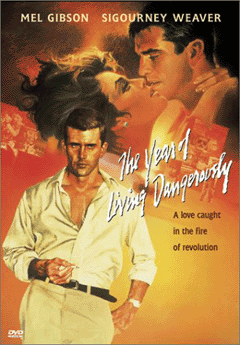
Peter Weir directed Mel Gibson in two of his best movies: Gallipoli and this one. The movie is set in Indonesia during the political turmoil of the 1960's. The key character is Billy Kwan, played by Linda Hunt (a role for which she won an Oscar). This movie works on lots of levels.

The Killing Fields (1984)

Before there was Law & Order, Sam Waterson played Sidney Schaunberg, who was a reporter for the New York Times during the Cambodian War and won a Pulitzer Prize for his stories. Dith Pran was the Cambodian who helped him. When the Americans evacuated, Pran and the other Cambodians who had helped them were left at the mercy of Pol Pot, who was out to kill pretty much everyone who disagreed with him. This is an amazing story of our human capacity to both endure and forgive.

The In-Laws (1979)

Yes, I said these were movies to watch more than once. I suppose I should also say you have to give yourself some time to recoup between viewings. I will close my list with one you can watch as many times as you want. This is one of the funniest movies ever. (The remake a couple years back sucked, by the way). Peter Falk is a former CIA guy who is pretty much of a loose cannon and Alan Arkin is a Manhattan dentist who has never colored outside the lines. They are great together.

There are more where those came from. I would love to hear the movies that matter to you.

Peace,
Milton

Wednesday, November 29, 2006

aging, grieving, dreaming, and laughing

I have several disconnected things on my mind, so here they are in no particular order.

_______________________________

I got my first birthday-related piece of mail today: an invitation to join the AARP now that I am turning fifty. I am old enough to remember when AARP stood for the American Association of Retired Persons, but that didn’t bring in enough money so now the letters are the official name, the same way Kentucky Fried Chicken became KFC so you would think they quit frying stuff.

In the course of conversations a couple of weeks back, I talked with an eighteen year old and an eighty-two year old. I got to thinking about it later and realized I am exactly the same number of years from either age. I don’t really have a point here, I just thought it was interesting.

_______________________________

I also got a package in the mail today from my friend, Billy Crockett, who has a new instrumental CD called Passages that is fourteen original pieces for classical guitar. (Listen to an excerpt of "Pilgrim I." There is also a companion score available. To quote him:
My hope is that you will, with Passages, be reminded of the wordless ways of the heart, of midnight voyages on the water, and of the simple gifts of old architecture and strings on wood.
You can purchase the record through his web site.

_______________________________

I read last night t
hat Robert Altman died a week ago of leukemia. He was eighty-one. Altman was a creative and unique voice in American filmmaking, hitting some out of the park and striking out brilliantly with others. His last movie, A Prairie Home Companion, is a gem. His first breakthrough, M*A*S*H, is worth a look, along with The Player and Shortcuts. CNN has a nice video tribute here. He never won an Oscar, but was given a lifetime achievement award this past year. "The major studios, since I've been involved with Hollywood . . . they make shoes and I make gloves," he said.

_______________________________

Speaking of movies, one of my favorites kept coming to mind today. I think I'm going to watch it tomorrow: Miss Firecracker. It is the story of Carnelle, a struggling girl who thinks winning the Miss Firecracker Beauty Pageant in her home town of Yazoo City, Mississippi will set her free to leave town "in a blaze of glory." Mary Steenburgen, Tim Robbins, Scott Glenn, and Alfre Woodard are also in the cast. It was directed by Thomas Schlamme, Aaron Sorkin's partner behind The West Wing and Studio 60 fame.

In the closing moments of the movie, Carnelle says, "I just want to know what I can reasonably expect out of life." Scott Glenn's answer is worth the trip.

_______________________________

I close with a video clip I Stumbled Upon: Tyson the Skateboarding Bulldog.

Sunday, November 12, 2006

random notes

Farrier was the word on the way to Birmingham; pedorthics was the word on the way home: “the art concerned with the design, manufacture, fit, and modification of foot appliances as prescribed for relief of painful or disabling conditions of the foot.”

On the flight from Atlanta to Manchester, I sat next to a woman who is a cobbler and had been at a pedorthics symposium to learn more about how to help people with their feet. Much like the guy who shoed horses so they could feel healthy, this woman did the same thing for humans. They also shared a love for their work. I came away amused that my trip had been bookended by feet.

_________________________________

Ginger doesn’t come home until tomorrow night, so I stopped at Blockbuster to pick up a movie to pass the time and ended up taking an unexpected journey. Kevin Wilmott wrote and directed The Confederate States of America, a mock documentary history of our nation as if the South had won the Civil War. It has the look and feel of Ken Burns’ work, using some original footage, along with old newsreels and educational films, and peppering it all with some bitingly satiric commercials.

I wasn’t sure what to expect when it started. I was half prepared for a very anti-Southern diatribe, which it was not. It was much more about “us” as a nation rather than “them” as the South. Wilmott does a wonderful job capturing our personality as a nation and resituating it in the changed outcome of the war; he also has a keen eye for what the consequences might have been. The most disturbing thing is some of them are not that much different than what life looks like in America today. It’s worth watching – and watching with some folks who can talk about it afterwards.

_________________________________

My father-in-law had a good weekend for the most part. There was obvious evidence that his short-term memory is fading and the family reunion offered him the chance to relish in the times he remembers with astounding detail. He’s a good storyteller and he’s got some great stories to tell. My favorite moment of the weekend came I was getting ready to fix dinner Friday night. Soon after Ginger and I met, I told her one day the difference in our families’ attitude towards food was when my family ate it was an event; her family ate so they didn’t die. Neither of my in-laws feel compelled to spend a lot of time in the kitchen.

“What are you fixing for dinner?” my father-in-law asked.
“Pot roast,” I answered.
With a mischievous look in his eye and a gentle smile aimed at his wife he said, “Pot roast – what’s that?” And then he laughed. We all did.

_________________________________

One more movie note that’s just too good to pass up. When I clicked back to the TV after the CSA movie was over, Cool Hand Luke was on. Paul Newman is the coolest guy ever. For no other reason than the scene just grabbed me, here is Luke’s prayer in the closing scenes of the film:
“Anybody here? Hey, Ol' Man, You home tonight? Can you spare a minute? It's about time we had a little talk. I know I'm a pretty evil fella. Killed people in the war and got drunk and chewed up municipal property and the like. I know I got no call to ask for much but even so, you gotta admit, you ain't dealt me no cards in a long time. It's beginnin' to look like you got things fixed so I can't never win out. Inside, outside, all 'em rules and regulations and bosses. You made me like I am. Just where am I supposed to fit in? Ol' Man, I gotta tell ya. I started out pretty strong and fast. But it's beginnin' to get to me. When does it end? What do ya got in mind for me? What do I do now? All right. All right. (He kneels on his knees and cups his hands in prayer.) On my knees, askin'. (pause) Yeah, that's what I thought. I guess I'm pretty tough to deal with, huh? A hard case. I guess I gotta find my own way.”

A few police cars drive up in front of the church. Dragline calls out to his friend from the church door: "Luke?"

Luke looks up and addresses an aside to God: "That's your answer ol' Man? I guess you're a hard case too."

Peace,
Milton